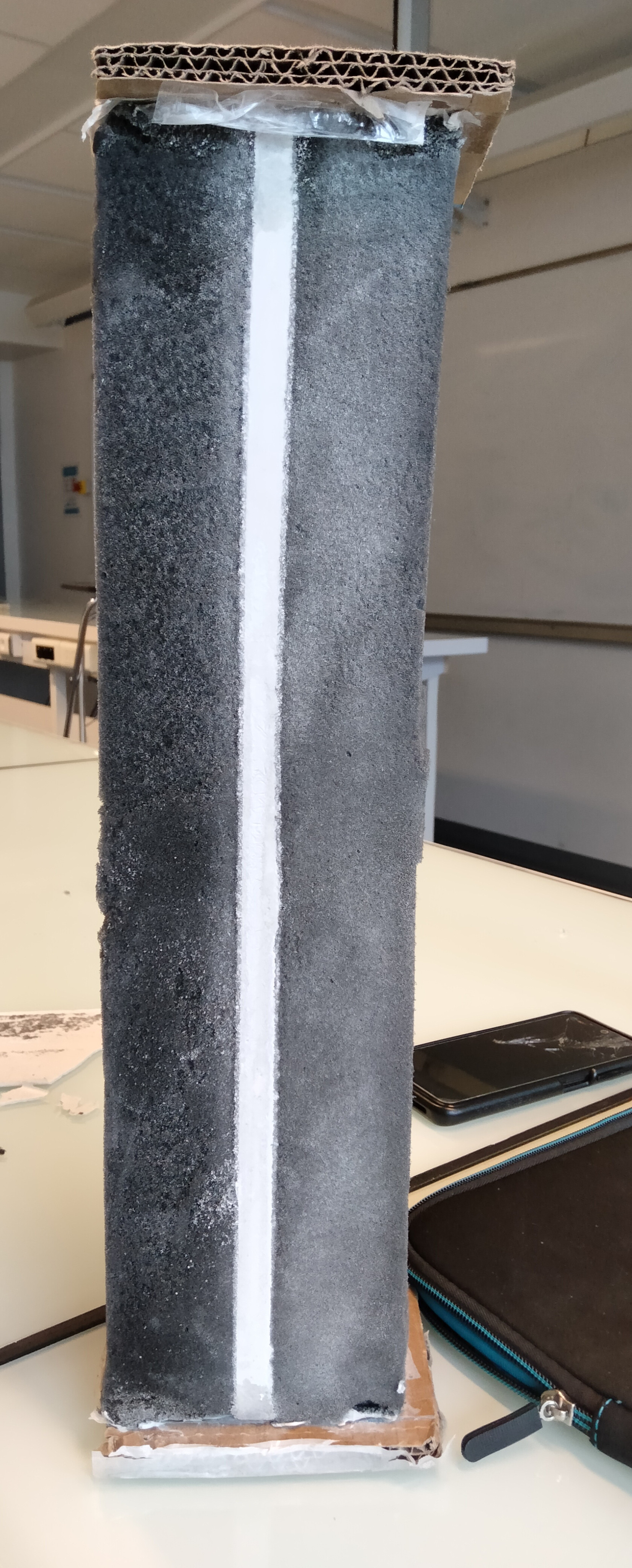
# Plis en mousse ⛰️

##### **Informations**

- **<span style="color: rgb(0, 0, 0);">Contacts :</span>** <span style="color: rgb(0, 0, 0);">Elphège et Ludivine</span> (<span style="color: rgb(0, 0, 0);"><ludivine.fars@etu.sorbonne-universite.fr>)</span>
- <span style="color: rgb(0, 0, 0);">**Etudes :** Licence 3 - Majeure Biologie, Mineure Sciences de la Terre</span>
- <span style="color: rgb(0, 0, 0);">**Dates du projet :** 24 Janvier 2025 au 24 Mai 2025</span>
- <span style="color: rgb(0, 0, 0);">**Responsables de l'UE LU3ST062** : Loïc Labrousse et Pierre Théry </span>
- <span style="color: rgb(0, 0, 0);">**Responsable Projet *Plis en Mousse*** : Claudio Rosenberg</span>

## <span style="color: rgb(0, 0, 0);">Pli en Mousse</span>

#### <span style="color: rgb(0, 0, 0);">Présentation</span>

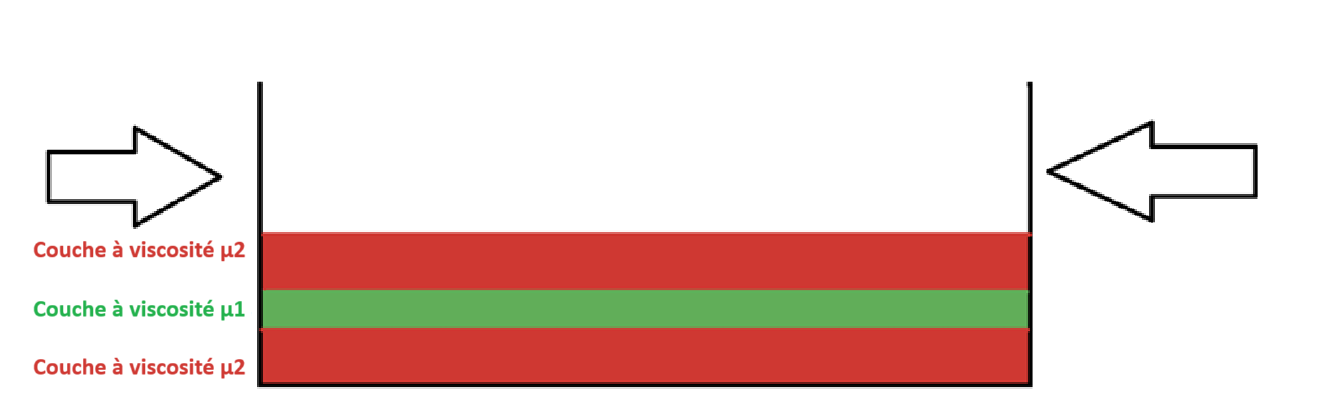
<span style="color: rgb(0, 0, 0);">Ce projet est né suite à la demande de Claudio Rosenberg de faire un modèle pédagogique de pli ayant les caractéristiques suivantes : une couche de viscosité (µ1) différente de sa matrice (µ2), matrice pouvant être modélisée par deux couches d'un même constituant. </span>

<span style="color: rgb(0, 0, 0);">En géologie, les matériaux terrestres peuvent être déformés de manière continue de 2 façons : par des déformations homogènes et/ou hétérogènes. Une déformation homogène, c'est quand deux surfaces parallèles dans l'état initial restent parallèles dans l'état final, on peut le modéliser par une translation. Ces déformations sont soit associées à un aplatissement/étirement (cisaillement pur, coaxial), soit s'accompagnent d'une composante rotationnelle (cisaillement simple, non coaxial). </span>

<span style="color: rgb(0, 0, 0);">Cependant, les matériaux terrestres ne s'harmonisent que rarement à une déformation dite homogène. En effet, de part le fait qu'ils soient de composition donc de viscosité et résistance différentes, ils auront tendance plutôt à induire des déformations hétérogènes. Les structures produites les plus classiques formées par ces déformations hétérogènes sont les plis. Ces derniers se forment lorsqu'une surface, initialement plane, modifie sa forme sous l'effet de contraintes tectoniques sans casser. </span><span style="color: rgb(0, 0, 0);">Les plis sont des déformations périodiques qui résultent d'instabilités de cisaillement dues à des contrastes de résistance et qui se développent selon une certaine longueur d'onde. </span>

<span style="color: rgb(0, 0, 0);">Plus il y a un contraste de viscosité entre la matrice et la couche au sein de cette matrice, plus la longueur d'onde du pli formé sera importante lorsqu'il y a contrainte mise sur la structure. Cela est notamment modélisé par une relation, établie par Biot (en 1961) : </span>

[![image.png](https://wiki.fablab.sorbonne-universite.fr/BookStack/uploads/images/gallery/2025-05/scaled-1680-/J0Iimage.png)](https://wiki.fablab.sorbonne-universite.fr/BookStack/uploads/images/gallery/2025-05/J0Iimage.png)

<span style="color: rgb(0, 0, 0);">Pour étudier des plis, on doit regarder la longueur d'onde des plis (distance entre les lignes d‘inflexion d‘un couple antiforme-synforme), leur amplitude (demi-distance entre les tangentes des charnières des antiformes ou synformes), mais aussi la disposition des plans axiaux des plis.</span>[  ](https://wiki.fablab.sorbonne-universite.fr/BookStack/uploads/images/gallery/2025-05/U9kimage.png)[![image.png](https://wiki.fablab.sorbonne-universite.fr/BookStack/uploads/images/gallery/2025-05/scaled-1680-/rq4image.png)](https://wiki.fablab.sorbonne-universite.fr/BookStack/uploads/images/gallery/2025-05/rq4image.png)
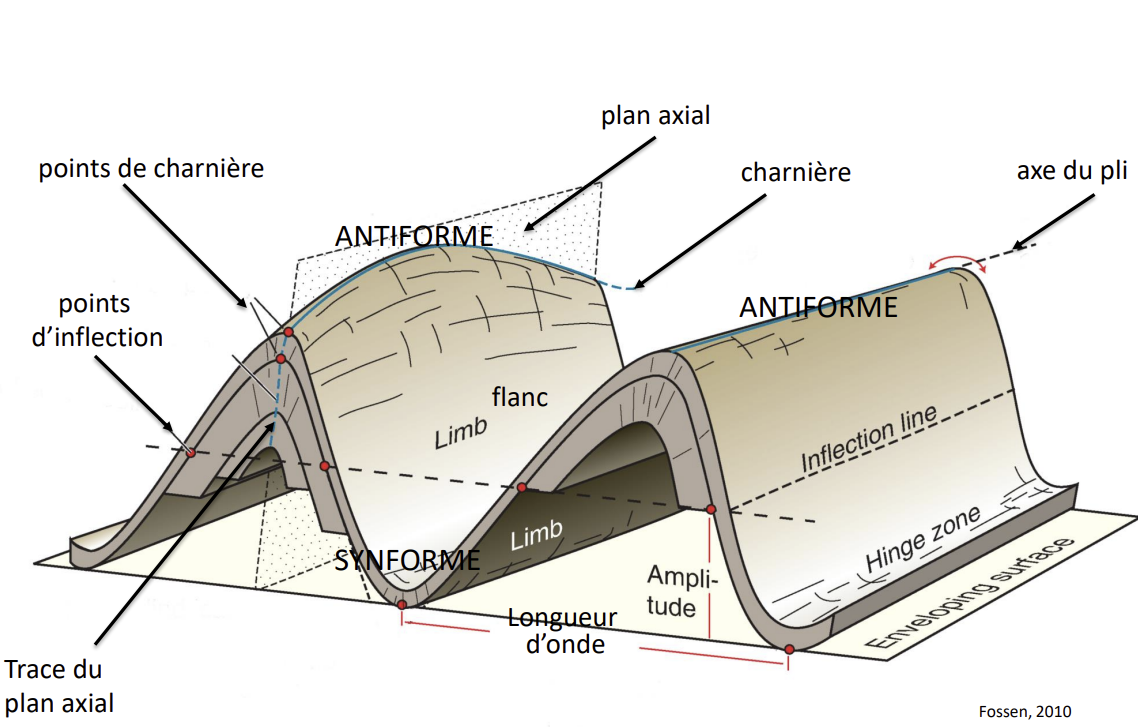
<span style="color: rgb(0, 0, 0);">Dans notre cas, nous allons essayer de produire un modèle avec une couche d'une certaine viscosité (µ1) se retrouvant plissée entre deux couches (considérées ici comme un encaissant ou une matrice) d'une viscosité différente (µ2) sous d'un raccourcissement parallèle. </span>

[![image.png](https://wiki.fablab.sorbonne-universite.fr/BookStack/uploads/images/gallery/2025-05/scaled-1680-/stnimage.png)](https://wiki.fablab.sorbonne-universite.fr/BookStack/uploads/images/gallery/2025-05/stnimage.png)

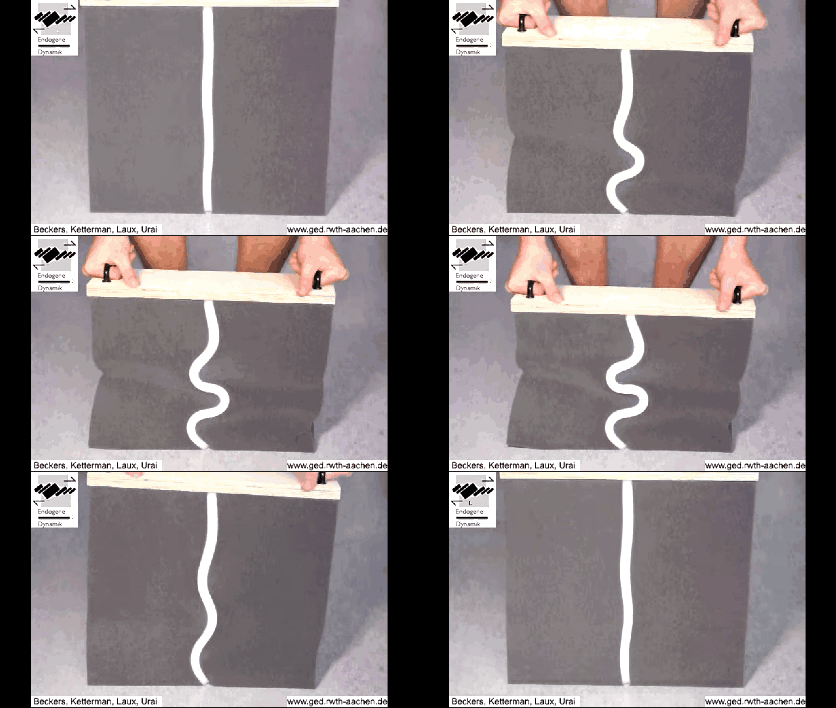
<span style="color: rgb(0, 0, 0);">Nous avons choisi, pour avoir 2 viscosités différentes, de la mousse comme matrice et du silicone comme couche à plisser. </span><span style="color: rgb(0, 0, 0);">Notre idée d'utiliser de la mousse et du silicone, vient quant à elle du visionnage d'une vidéo (sur Youtube) de modélisation d'un pli grâce à de la mousse et du silicone, modélisation produite par Markus Beckers, Michael Ketterman, Dennis Laux et Janos Urai : </span><span style="font-size: 11pt; font-family: Arial,sans-serif; color: #000000; background-color: transparent; font-weight: 400; font-style: normal; font-variant: normal; text-decoration: none; vertical-align: baseline; white-space: pre-wrap;">[<span style="font-size: 11pt; font-family: Arial, sans-serif; background-color: transparent; font-weight: 400; font-style: normal; font-variant: normal; text-decoration: underline; text-decoration-skip-ink: none; vertical-align: baseline; white-space: pre-wrap;">https://youtu.be/jd3hG2PNdUo?si=tqjAjx20PR8gEWnk</span>](https://youtu.be/jd3hG2PNdUo?si=tqjAjx20PR8gEWnk)</span>

<span style="color: rgb(0, 0, 0);"> ![(305) Folding of a single, thick silicone layer (Structural Geology, analogue modelling) - YouTube - Google Chrome 2025-05-04 11-59-21.gif](https://wiki.fablab.sorbonne-universite.fr/BookStack/uploads/images/gallery/2025-05/305-folding-of-a-single-thick-silicone-layer-structural-geology-analogue-modelling-youtube-google-chrome-2025-05-04-11-59-21.gif)</span>

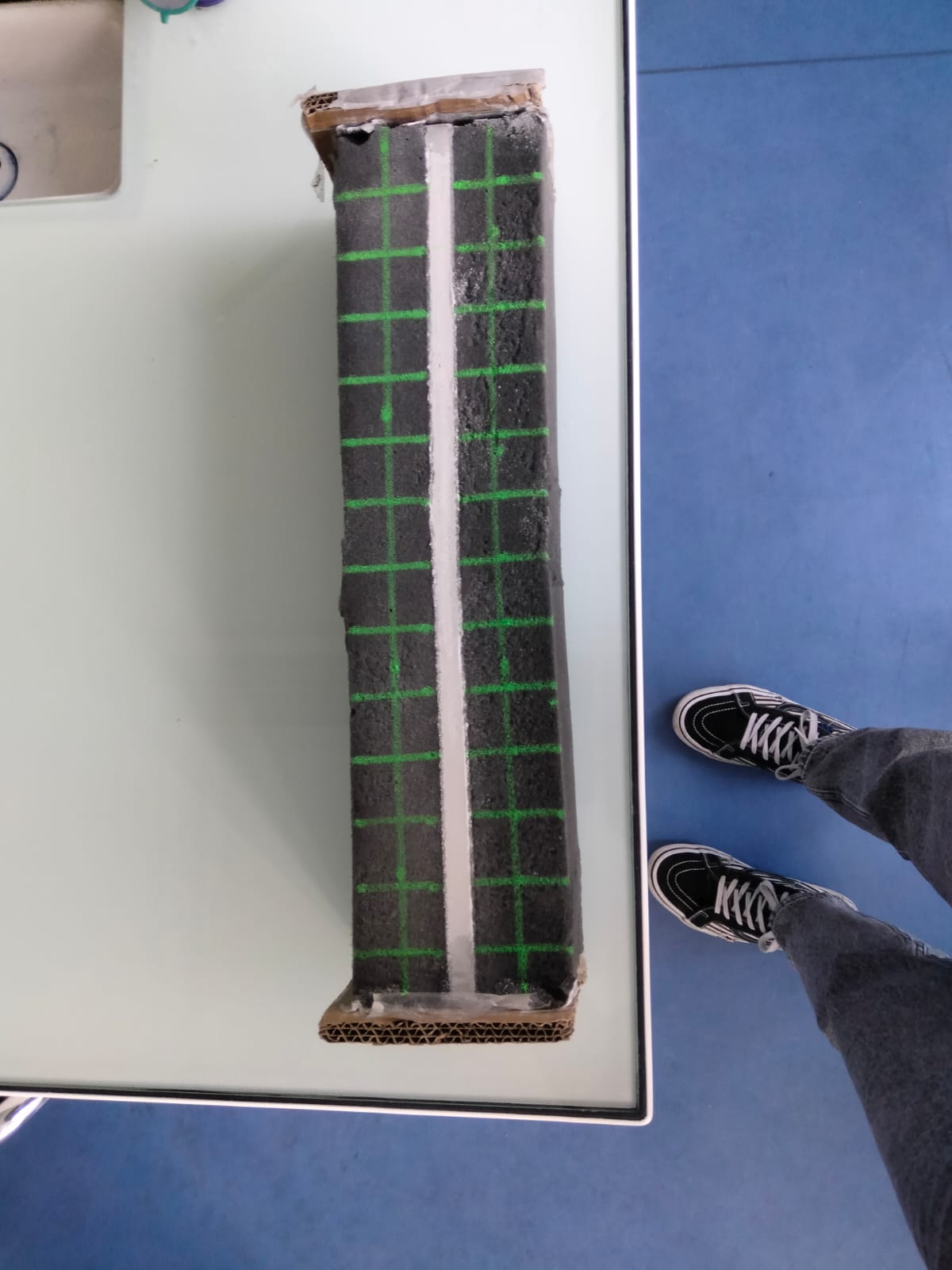
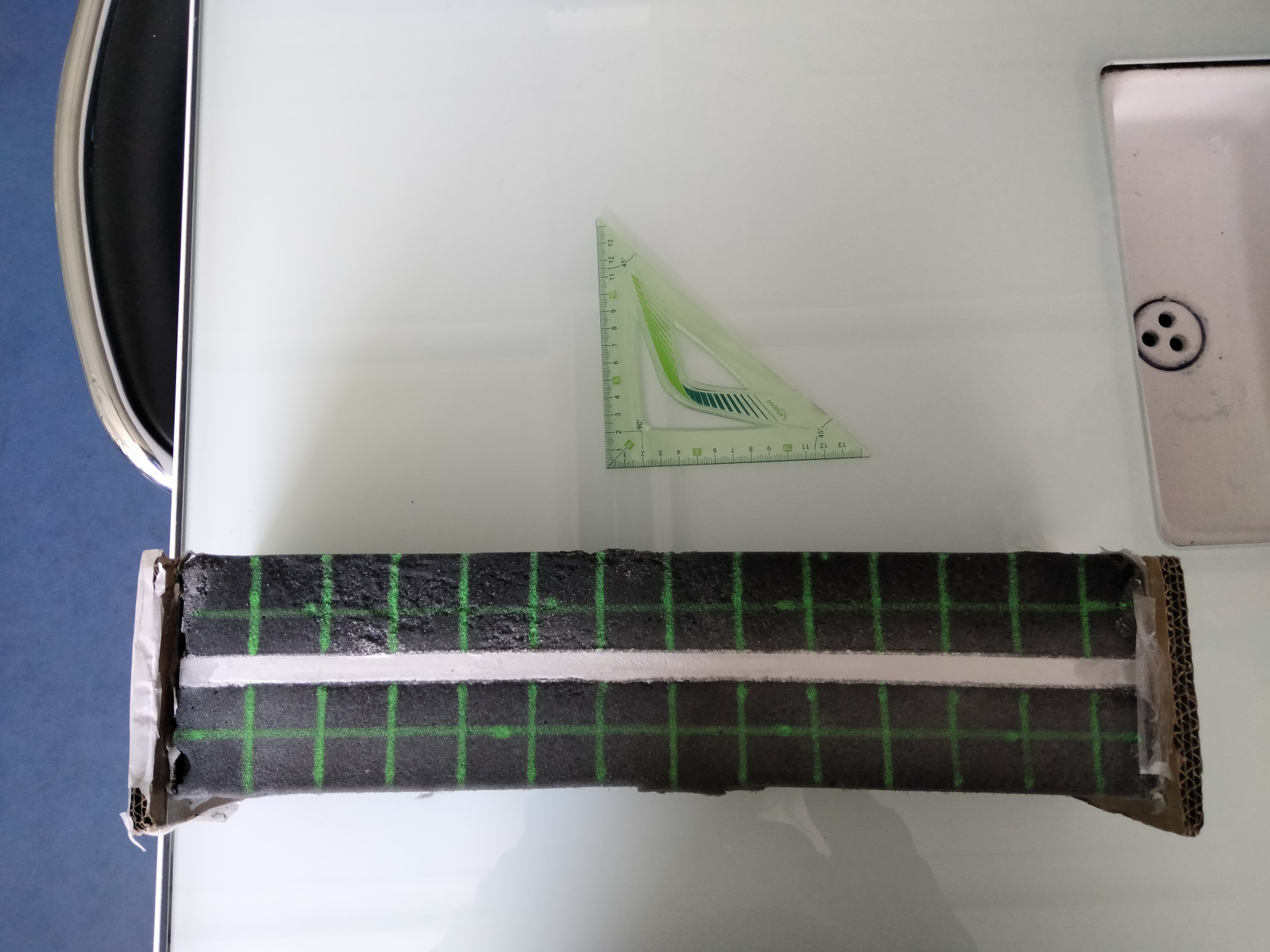
<span style="color: rgb(0, 0, 0);">Nous rajouterons un cadrillage, dessiné sur chacun de nos modèles, permettant d'avoir des points d'intersections disposés sur la mousse et à la limite mousse/silicone afin de suivre les déplacements de ces points et ainsi mieux comprendre et visualiser les déformations du silicone, mais aussi de la mousse lorsque les contraintes sont effectives. Nous allons, par la suite, utilisé un code informatique Python, créé par Loïc Labrousse, que nous allons modifié afin qu'il soit plus simple d'utilisation, afin de créer des ellipses de vitesses de déformations déduites des points d'intersections précédemment dessinés, permettant d'avoir des données calculées plus précises que de simples observations visuelles. </span>

#### <span style="color: rgb(0, 0, 0);">Matériel</span>

<details id="bkmrk-premier-mod%C3%A8le-%28mat%C3%A9"><summary>Pour le 1er modèle</summary>

- <span style="color: rgb(0, 0, 0);">2 plaques de mousse synthétique d'isolation à cellules ouvertes avec un diamètre cellulaire ~ 1mm (1000 µ) de dimension : 41.8 cm x 4.75 cm x 11.5 cm</span>
- <span style="color: rgb(0, 0, 0);">Du silicone RTV 151 (Esprit Composite) dans l'espace de la couche de dimensions 41.8 cm x 1.7 cm x 11.5 cm (donc de volume d'environ 820cm<sup>3</sup>) + dans le fond de dimension 41,8 cm x 11,2 cm x 0,5cm (donc de volume d'environ 235cm<sup>3</sup>), de densité d=1,25 et d'une viscosité de 8000 mPa.s et d'une </span><span style="color: rgb(0, 0, 0);">dureté de (Shore A) 20. Sa durée de durcissement est de 12h</span>
- <span style="color: rgb(0, 0, 0);">Le catalyseur/durcisseur correspondant (vendu avec)</span>
- <span style="color: rgb(0, 0, 0);">Talc</span>
- <span style="color: rgb(0, 0, 0);">Plaques en cartons</span>
- <span style="color: rgb(0, 0, 0);">Scotch</span>
- <span style="color: rgb(0, 0, 0);">Cutter et paire de ciseaux</span>
- <span style="color: rgb(0, 0, 0);">Colle forte</span>
- <span style="color: rgb(0, 0, 0);">Feutres marqueurs de couleurs (notamment pour le cadrillage)</span>
- <span style="color: rgb(0, 0, 0);">Une balance</span>
- <span style="color: rgb(0, 0, 0);">Un contenant pour mélanger le silicone et le catalyseur</span>
- <span style="color: rgb(0, 0, 0);">Quelque chose pour mélanger le silicone et le catalyseur (cuillère, agitateur)</span>

</details><details id="bkmrk-deuxi%C3%A8me-mod%C3%A8le-%28mat"><summary>Pour le 2nd modèle</summary>

- <span style="color: rgb(0, 0, 0);">2 plaques de mousse synthétique d'isolation à cellules ouvertes avec un diamètre cellulaire ~ 1mm (1000 µ) de dimension : 64 cm x 4,1 cm x 10 cm</span>
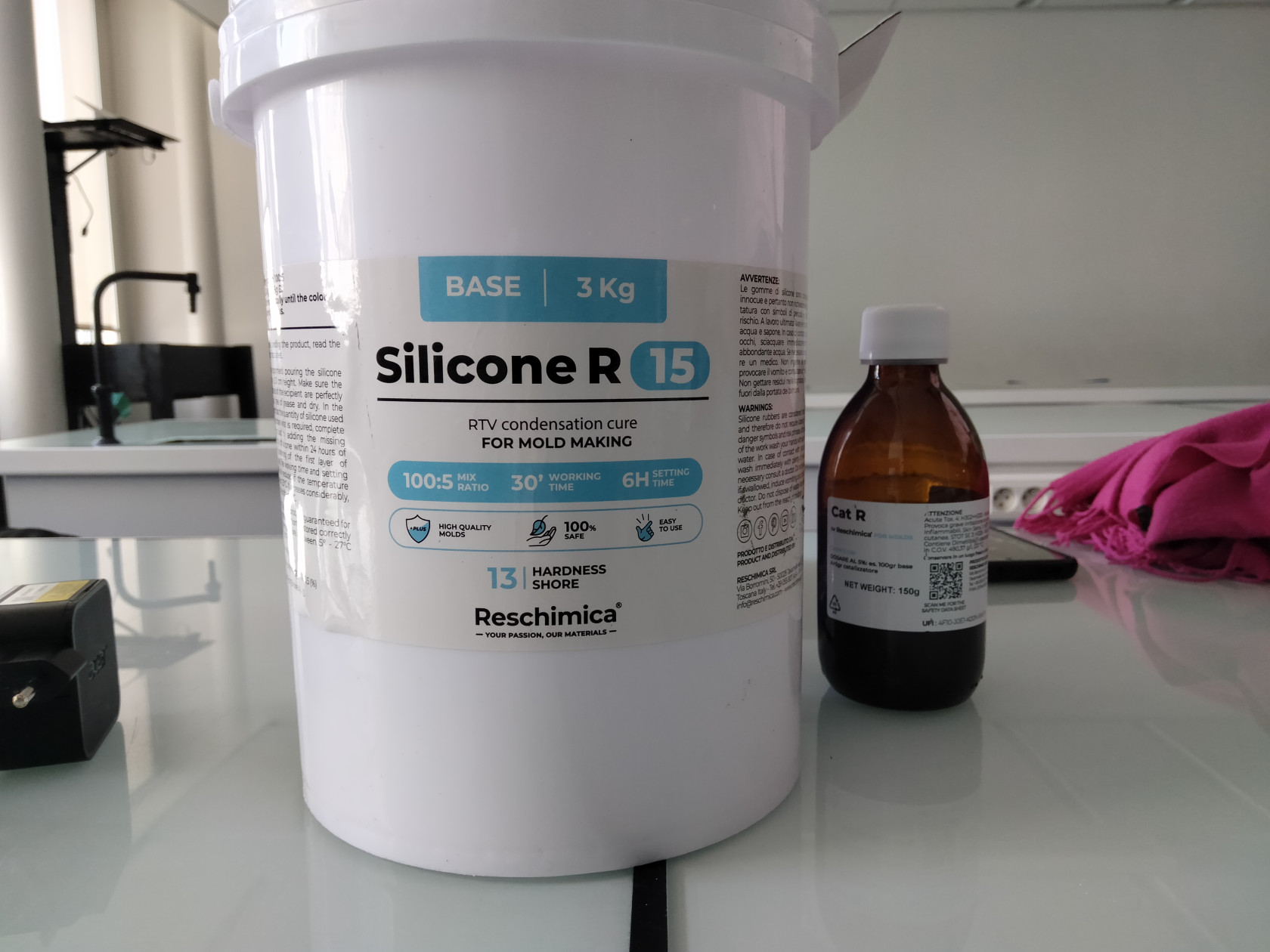
- <span style="color: rgb(0, 0, 0);">1 couche de silicone RTV 151 au centre de dimension : 64 cm x 1.2 cm x 10 cm , de densité d=1,051 à 20°C, d'une viscosité 27,95 mPa.s, et d'une dureté de (Shore A) 13</span>
- <span style="color: rgb(0, 0, 0);">Le catalyseur/durcisseur correspondant (vendu avec)</span>
- <span style="color: rgb(0, 0, 0);">Talc</span>
- <span style="color: rgb(0, 0, 0);">Plaques en cartons</span>
- <span style="color: rgb(0, 0, 0);">Scotch</span>
- <span style="color: rgb(0, 0, 0);">Cutter et paire de ciseaux</span>
- <span style="color: rgb(0, 0, 0);">Colle forte</span>
- <span style="color: rgb(0, 0, 0);">Feutres marqueurs de couleurs (notamment pour le cadrillage)</span>
- <span style="color: rgb(0, 0, 0);">Une balance</span>
- <span style="color: rgb(0, 0, 0);">Un contenant pour mélanger le silicone et le catalyseur</span>
- <span style="color: rgb(0, 0, 0);">Quelque chose pour mélanger le silicone et le catalyseur (cuillère, agitateur)</span>

</details>#### <span style="color: rgb(0, 0, 0);">Protocole de Fabrication des Modèles</span>

<span style="text-decoration: underline;"><span style="color: rgb(0, 0, 0); text-decoration: underline;">Dimensions de notre premier modèle (à gauche) puis pour notre second modèle (à droite) :</span></span>

[![Capture d’écran 2025-05-22 102612.png](https://wiki.fablab.sorbonne-universite.fr/BookStack/uploads/images/gallery/2025-05/scaled-1680-/capture-decran-2025-05-22-102612.png)](https://wiki.fablab.sorbonne-universite.fr/BookStack/uploads/images/gallery/2025-05/capture-decran-2025-05-22-102612.png)

<span style="color: rgb(0, 0, 0);"><span style="text-decoration: underline;">Protocole :</span> </span>

[![méthode0.png](https://wiki.fablab.sorbonne-universite.fr/BookStack/uploads/images/gallery/2025-05/scaled-1680-/methode0.png)](https://wiki.fablab.sorbonne-universite.fr/BookStack/uploads/images/gallery/2025-05/methode0.png)

<span style="color: rgb(0, 0, 0);">0 - Créer un carton avec les dimensions voulues où nous y calleront les 2 mousses et où nous feront couler le silicone. Dans notre cas, nous avons juste, à partir de plaques de cartons coupées avec les dimensions voulues (voir par exemple image ci-dessus) et de scotch, formé un moule. L'utilité du carton comme moule est qu'il suffit de couper le scotch avec un cutter à la dernière étape pour démouler certaines faces. </span>

<span style="color: rgb(0, 0, 0);">[![Capture d’écran 2025-05-19 101541.png](https://wiki.fablab.sorbonne-universite.fr/BookStack/uploads/images/gallery/2025-05/scaled-1680-/capture-decran-2025-05-19-101541.png)](https://wiki.fablab.sorbonne-universite.fr/BookStack/uploads/images/gallery/2025-05/capture-decran-2025-05-19-101541.png)</span>

<span style="color: rgb(0, 0, 0);">1 - Mettre du talc au fond du carton/du moule </span>

<span style="color: rgb(0, 0, 0);">1' - Couler du silicone mélangé à son catalyseur sur le fond (pour éviter que le silicone central coule totalement vers le bas)</span>

<details id="bkmrk-protocole-masse-sili"><summary>Protocole Masse Silicone et Catalyseur</summary>

<span style="color: rgb(0, 0, 0);">Pour avoir la bonne masse de silicone et de catalyseur, il faut prendre en compte plusieurs données. Le rapport silicone/catalyseur en premier lieu, ici de 100:5 (c'est-à-dire que pour 100g au total, il faut 5g de catalyseur et 95g de silicone), la densité du silicone et du catalyseur, ainsi que le volume dans lequel il sera versé (selon les dimensions de notre moule, c'est-à-dire selon le volume de silicone que l'on souhaite au fond permettant l'accrochage des mousses (étape 1') ou les dimensions de la place qu'aura la couche de silicone centrale (étape 3)). Autrement dit, on a m = ρ\*V avec m en g, ρ en g/cm<sup>3</sup> et V en cm<sup>3</sup> . En rajoutant les proportions, cela donne m=0,95(ρ<sub>silicone</sub>\*V<sub>silicone</sub>) + 0,05(ρ<sub>catalyseur</sub>\*V<sub>catalyseur</sub>). </span>

</details><span style="color: rgb(0, 0, 0);">2 - Enduire généreusement de talc les mousses les faces qui seront en contact avec le silicone : les faces du bas en contact avec la base et celles, plus grandes, qui seront en contact avec la couche centrale du silicone (c'est-à-dire sur les schémas ci-dessus les faces entre le gris de la mousse et le jaune du silicone)</span>

<span style="color: rgb(0, 0, 0);">2' - Avant de poser les 2 mousses sur le fond, ajouter de la colle forte sur les faces de mousse qui seront en contact avec les côtés extérieurs du modèles (face A sur schémas ci-dessus) où seront appliquées les contraintes (pour meilleures préhension du modèle) </span>

<span style="color: rgb(0, 0, 0);">2'' - Poser des 2 mousses sur le fond (avant que le silicone se soit trop rigidifié de telle sorte que le silicone colle bien aux mousses) en vérifiant bien que la colle agit des deux côtés extérieurs également</span>

<span style="color: rgb(0, 0, 0);">3 - Couler le silicone entre les 2 mousses peu à peu</span>

<span style="color: rgb(0, 0, 0);">4- Après avoir attendu (au moins 24h) que le silicone se soit rigidifié, enlever le moule, c'est-à-dire décoller les deux faces les plus grande du moule/ du carton (faces B sur les schémas ci-dessus) ainsi que la base. Si suffisamment de talc a été mis au fond, normalement enlever la base n'est pas compliqué, et les deux faces les plus grandes étant celles sans contact avec silicone ou colle, il est normalement simple de les enlever aussi. </span>

<span style="color: rgb(0, 0, 0);">5 - Dessiner le cadrillage avec un feutre marqueur de couleur différente de la mousse</span>

[![image.png](https://wiki.fablab.sorbonne-universite.fr/BookStack/uploads/images/gallery/2025-05/scaled-1680-/xRmimage.png)](https://wiki.fablab.sorbonne-universite.fr/BookStack/uploads/images/gallery/2025-05/xRmimage.png)<span style="text-decoration: underline;"><span style="color: rgb(0, 0, 0); text-decoration: underline;">Schéma du montage étape par étape puis schéma du cadrillage</span></span>

#### <span style="color: rgb(0, 0, 0);">Code Informatique</span>

<details id="bkmrk-code-python-import-n"><summary>Code Python</summary>

```python
import numpy as np
from matplotlib import pyplot as plt
from matplotlib import image as img
from scipy.spatial import Delaunay # pour tracer les triangles
from matplotlib import colormaps as cmp
from matplotlib import colors as cl
from matplotlib import cm
import matplotlib
matplotlib.use('Qt5Agg')

def pick_points(image, n):
    # Permet de piquer les points d'un repère et de les mettre à l'échelle
    fig, ax = plt.subplots()
    plt.imshow(image)
   
    # Pointer le repère dans cet ordre : origine, axe des x, axe des y
    plt.title('Cliquer sur les 3 points du repère O, X, Y')
    R = plt.ginput(3, show_clicks=1)
    print("Points sélectionnés pour le repère (O, X, Y) :")
    print(R)  # Affiche la structure exacte des points
    R = np.array(R)
    print("Structure de R après conversion en numpy array :")
    print(R)
   
    # Vérification des dimensions
    if R.ndim != 2 or R.shape[1] != 2:
        print(f"Erreur dans la structure de R : R.ndim={R.ndim}, R.shape={R.shape}")
        raise ValueError("Les points sélectionnés ne sont pas sous forme de coordonnées 2D")
   
    ax.plot(R[:, 0], R[:, 1], 'r+')
   
    # Pointer les noeuds de la grille (clics illimités jusqu'à touche)
    plt.title("Cliquez les noeuds de la grille, puis appuyez sur Entrée pour terminer")
    print("🖱 Cliquez les noeuds... puis appuyez sur Entrée quand vous avez terminé.")

    points = []
    compteur = 1
    while True:
        pts = plt.ginput(1, timeout=0)
        if not pts:
            break
        points.append(pts[0])
        print(f"🖱 Point {compteur} cliqué : {pts[0]}")
        ax.plot(pts[0][0], pts[0][1], 'g+')
        plt.draw()
        compteur += 1
    
    plt.show()
    N = np.array(points)
    print("✅ Total de points cliqués :", len(N))
   
    # Vérification des dimensions
    if N.ndim != 2 or N.shape[1] != 2:
        print(f"Erreur dans la structure de N : N.ndim={N.ndim}, N.shape={N.shape}")
        raise ValueError("Les noeuds sélectionnés ne sont pas sous forme de coordonnées 2D")
   
    ax.plot(N[:, 0], N[:, 1], 'r+')
    plt.show()
   
    # Fermer la fenêtre après l'affichage
    plt.close(fig)  # Ajout de plt.close pour fermer la fenêtre après que l'utilisateur ait sélectionné les points.
   
    # Mettre les distances à l'échelle
    unite_x = R[1, 0] - R[0, 0]
    unite_y = R[2, 1] - R[0, 1]
    N[:, 0] = N[:, 0] / unite_x
    N[:, 1] = N[:, 1] / unite_y
    return N

def vdef_de_deplt(xi, yi, xf, yf):
    # calcule les vitesses de deplacements a partir des positions et vitesses des stations  
   
    xi = xi - np.mean(xi)
    yi = yi - np.mean(yi)
    xf = xf - np.mean(xf)
    yf = yf - np.mean(yf)
   
    A = np.array([[np.sum(xi*xi), np.sum(xi*yi)],
         [np.sum(xi*yi), np.sum(yi*yi)]])
    B1 = np.array([np.sum(xi*xf), np.sum(yi*xf)])
    B1 = B1.transpose()
    B2 = np.array([np.sum(xi*yf), np.sum(yi*yf)])
    B2 = B2.transpose()
   
    X1 = np.linalg.lstsq(A,B1,rcond = None)
    X2 = np.linalg.lstsq(A,B2,rcond = None)
    ab = X1[0]
    cd = X2[0]
   
    D = ab[0]*cd[1] - ab[1]*cd[0]
    C = ab[0]**2 +ab[1]**2 + cd[0]**2 + cd[1]**2
    X = np.sqrt(0.5*(C + np.sqrt(C**2 - 4*D**2)))  # étirement
    Z = np.sqrt(0.5*(C - np.sqrt(C**2 - 4*D**2))) # raccourcissement
    Theta = 0.5*np.arctan2(2*(ab[0]*cd[0] + ab[1]*cd[1]),(ab[0]**2 +ab[1]**2 - cd[0]**2 - cd[1]**2))
    dil = D - 1
    return X, Z, Theta, dil

def plot_fleche(x, y, val, angle, coul): # dessine les axes de l'ellipsoide de deformation
    echelle = 0.1 # pour mettre à l'echelle
    taille_fleche = 0.01 # taille de la fleche
    dx = val*echelle*np.cos(angle)
    dy = val*echelle*np.sin(angle)
    plt.arrow(x, y, dx, dy, color = coul, length_includes_head = True, width = taille_fleche)
    plt.arrow(x, y, -dx, -dy, color = coul, length_includes_head = True, width = taille_fleche)
   
n_n = 90 # nombre de noeuds à pointer
init = img.imread('SansContraintes.jpg') # nom des fichiers ... ils doivent etre ds le meme rep que le .py
fin = img.imread('AvecContraintes.jpg')

N_init = pick_points(init,n_n)
N_fin = pick_points(fin,n_n)

# generer les triangles de Delaunay
triangles_i = Delaunay(N_init)
# inverser la matrice de déplacement
X, Z, Theta, dil = [], [], [], []
for tri in triangles_i.simplices:
    xi, yi = N_init[tri,0], N_init[tri,1]
    xf, yf = N_fin[tri,0], N_fin[tri,1]
    r1, r2, r3, r4 = vdef_de_deplt(xi, yi, xf, yf)
    X.append(r1)
    Z.append(r2)
    Theta.append(r3)
    dil.append(r4)
X = np.array(X)
Z = np.array(Z)
Theta = np.array(Theta)
dil = np.array(dil)
norm_def = np.hypot(X,Z) # hypothenuse

# trouver les barycentres des triangles
coordc = []
for tri in triangles_i.simplices:
    xc = np.mean(N_fin[tri,0])
    yc = np.mean(N_fin[tri,1])
    coordc.append([xc, yc])
coordc = np.array(coordc)

cmap = cmp['RdBu']
cmap = cmap.reversed()
lim_coul = [1, 2] # a modifier

fig1, ax1 = plt.subplots()
ax1.axis('equal')

plt.plot(N_fin[:,0], N_fin[:,1], 'ko')
plt.tripcolor(N_fin[:,0], N_fin[:,1], triangles_i.simplices, norm_def,
              color = 'black', linewidth = 0.5, cmap=cmap, vmin=lim_coul[0], vmax = lim_coul[1])
norm = cl.Normalize(lim_coul[0], lim_coul[1])
fig1.colorbar(cm.ScalarMappable(norm=norm, cmap=cmap), ax=ax1,
              orientation = 'horizontal', location = 'bottom', label = 'deformation finie')
for x, y, v, Th in zip(coordc[:,0], coordc[:,1], X, Theta):
     plot_fleche(x, y, v, Th, 'white')
for x, y, v, Th in zip(coordc[:,0], coordc[:,1], Z, Theta+np.pi/2):
         plot_fleche(x, y, v, Th, 'black')
         
plt.show()
```

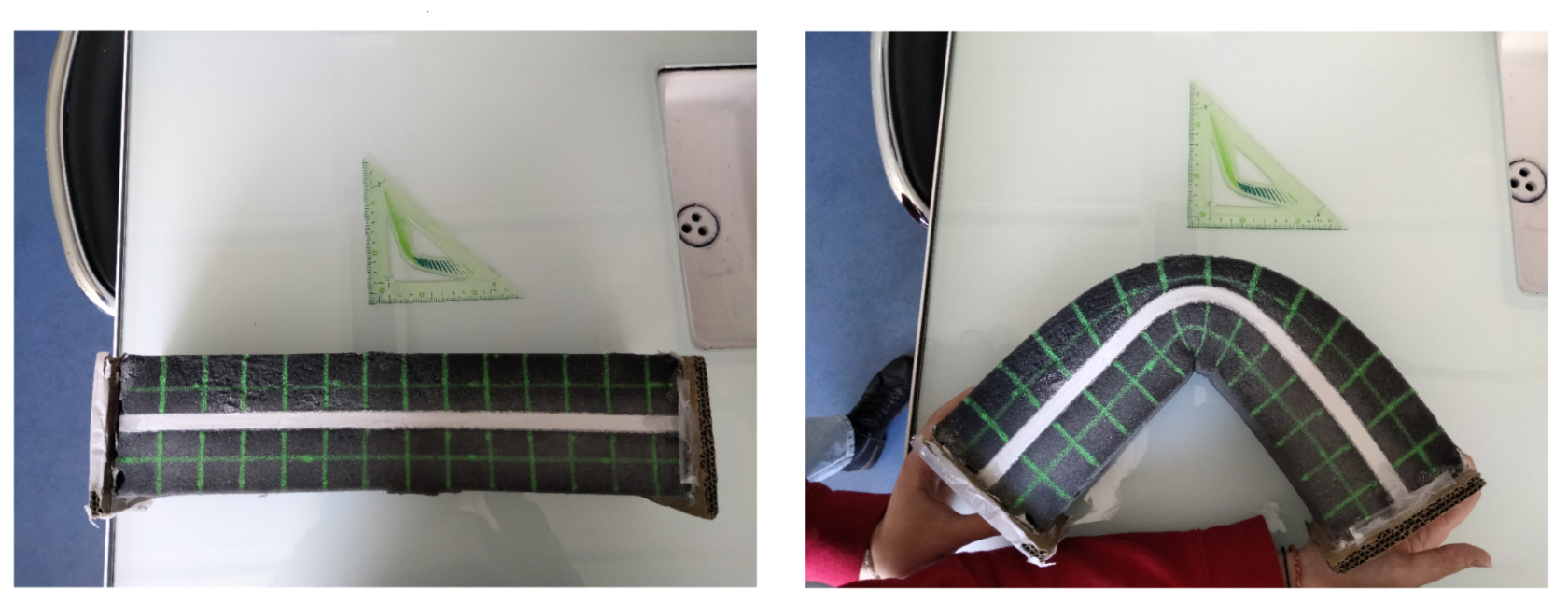
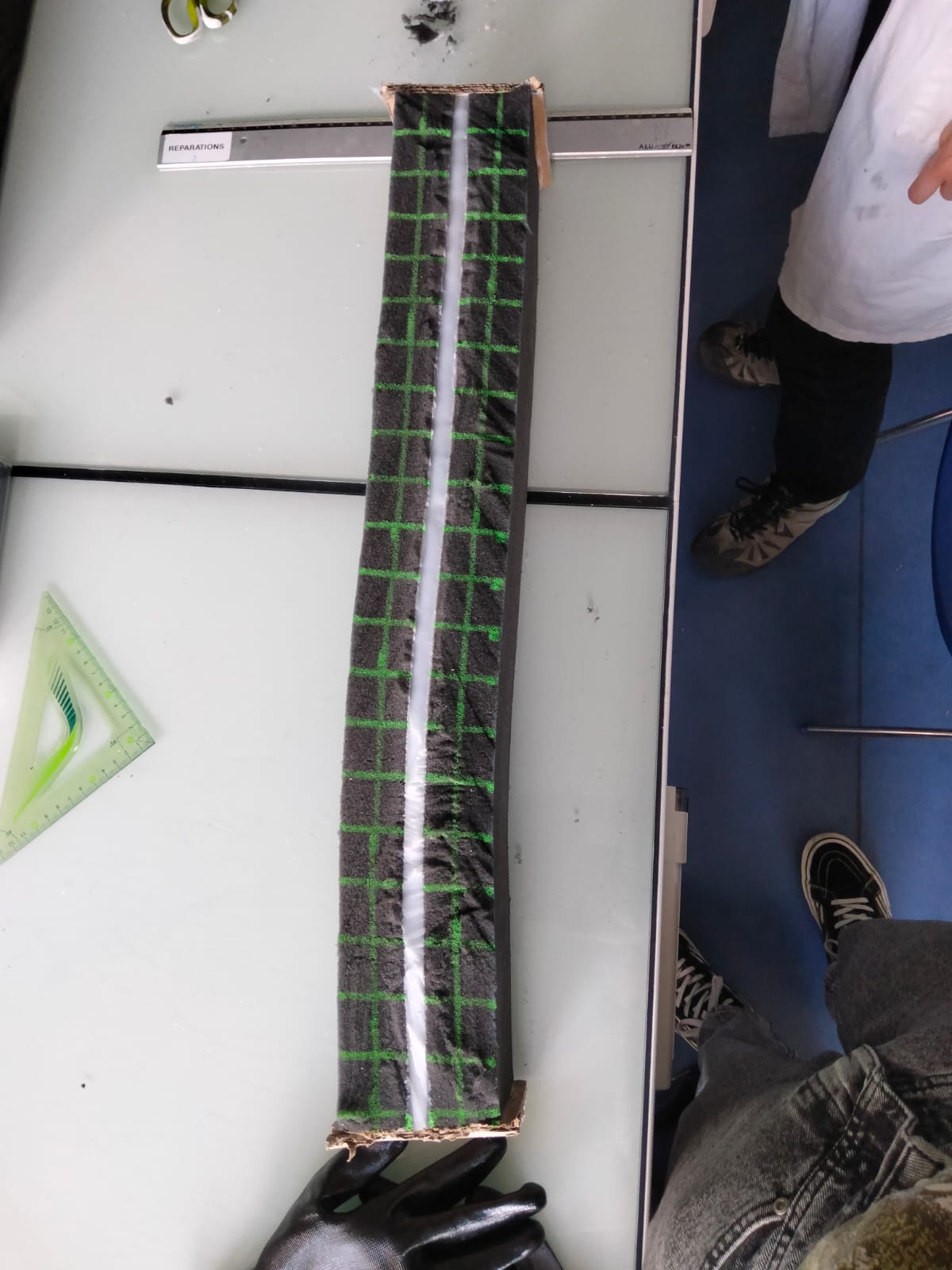
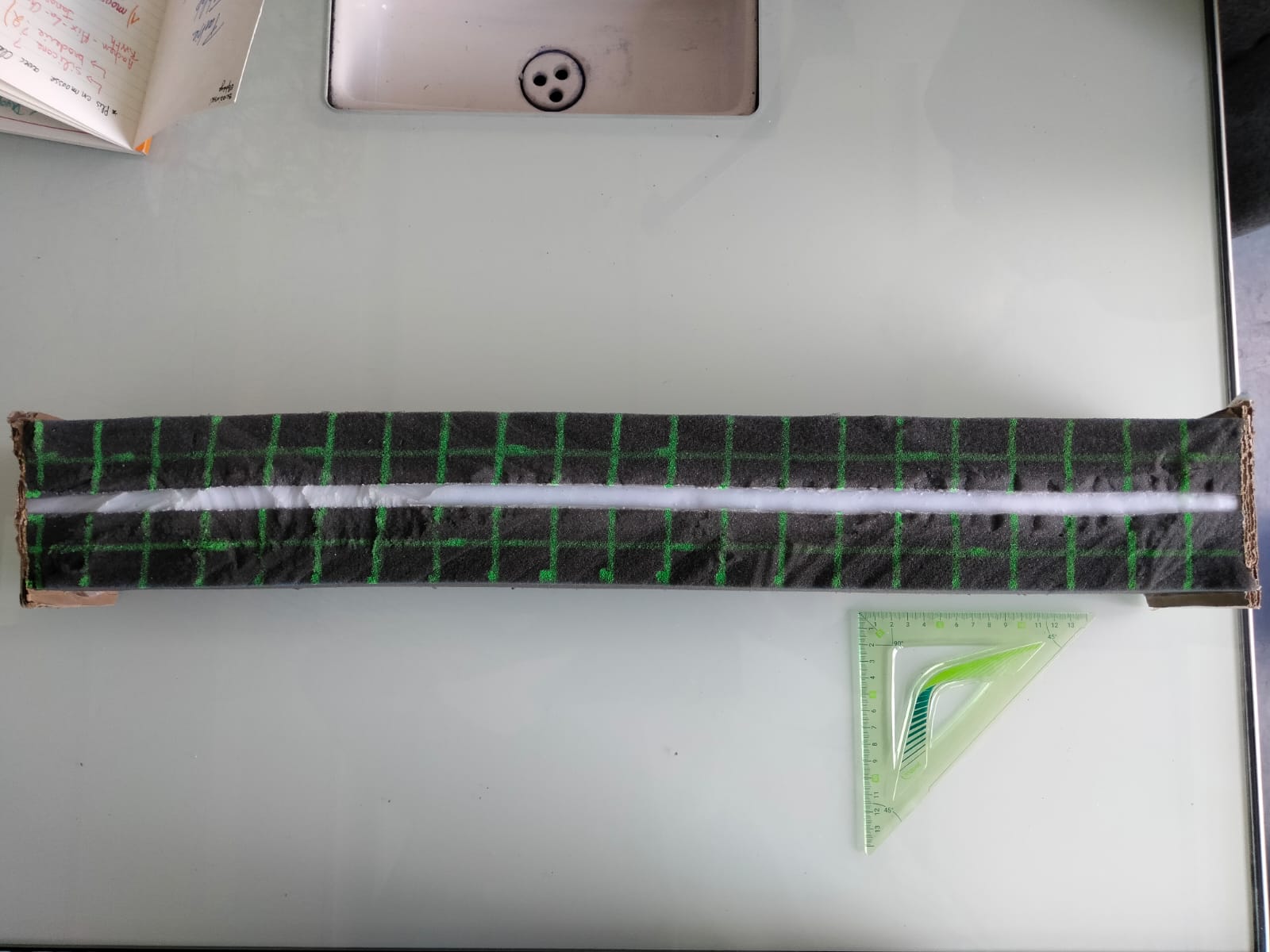
</details><span style="color: rgb(0, 0, 0);">Les fichiers "SansContraintes.jpg" et "AvecContraintes.jpg" sont les images du modèle quadrillé sans contraintes puis avec (le deuxième étant le prototype à l'état plissé) suivantes</span>

<details id="bkmrk-fichiers-photos-prot"><summary>Fichiers Photos Prototype 1</summary>

<span style="color: rgb(0, 0, 0);">[![image.png](https://wiki.fablab.sorbonne-universite.fr/BookStack/uploads/images/gallery/2025-05/scaled-1680-/axEimage.png)](https://wiki.fablab.sorbonne-universite.fr/BookStack/uploads/images/gallery/2025-05/axEimage.png)Les photos sont ici celles de notre 1er prototype. </span>

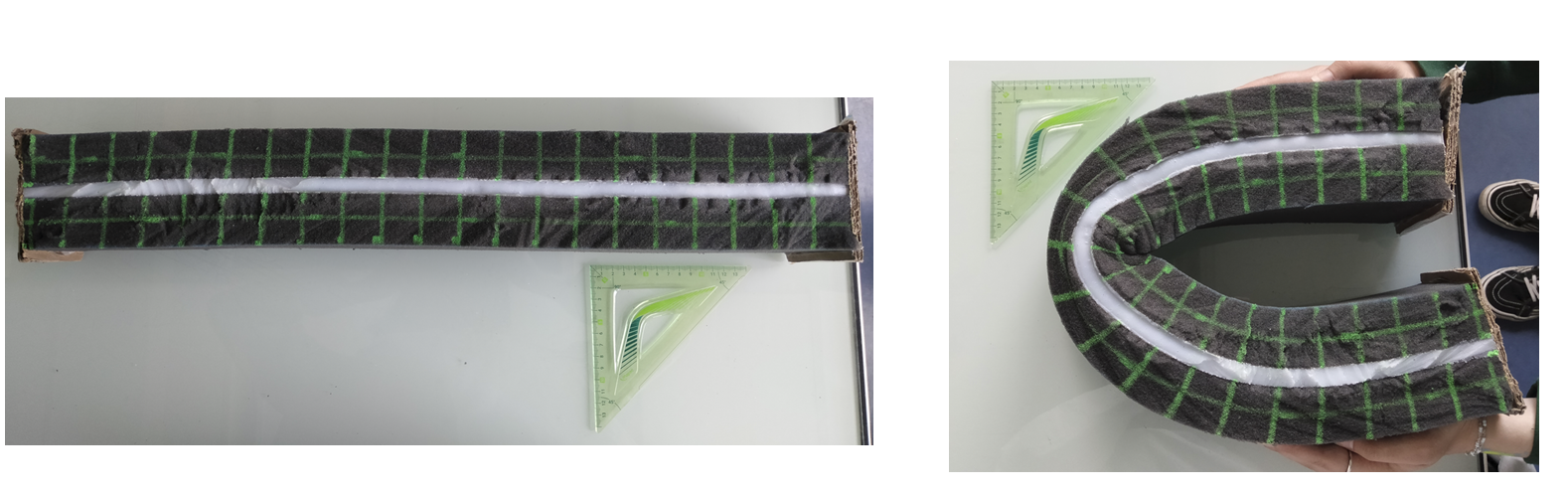
</details><span style="color: rgb(0, 0, 0);">Pour faire fonctionner le code avec un autre modèle, donc d'autres photos, il suffit soit de renommer les photos avec ces noms, soit de modifier le code. Par exemple, nous, nous avons reproduit l'expérience avec notre 2nd prototype :</span>

<details id="bkmrk-fichiers-photos-prot-1"><summary>Fichiers Photos Prototype 2</summary>

[![image.png](https://wiki.fablab.sorbonne-universite.fr/BookStack/uploads/images/gallery/2025-05/scaled-1680-/v1aimage.png)](https://wiki.fablab.sorbonne-universite.fr/BookStack/uploads/images/gallery/2025-05/v1aimage.png)

</details>#### <span style="color: rgb(0, 0, 0);">Résultats</span>

<span style="text-decoration: underline; color: rgb(0, 0, 0);">Pour le premier modèle :</span>

[![image.png](https://wiki.fablab.sorbonne-universite.fr/BookStack/uploads/images/gallery/2025-05/scaled-1680-/teHimage.png)](https://wiki.fablab.sorbonne-universite.fr/BookStack/uploads/images/gallery/2025-05/teHimage.png)

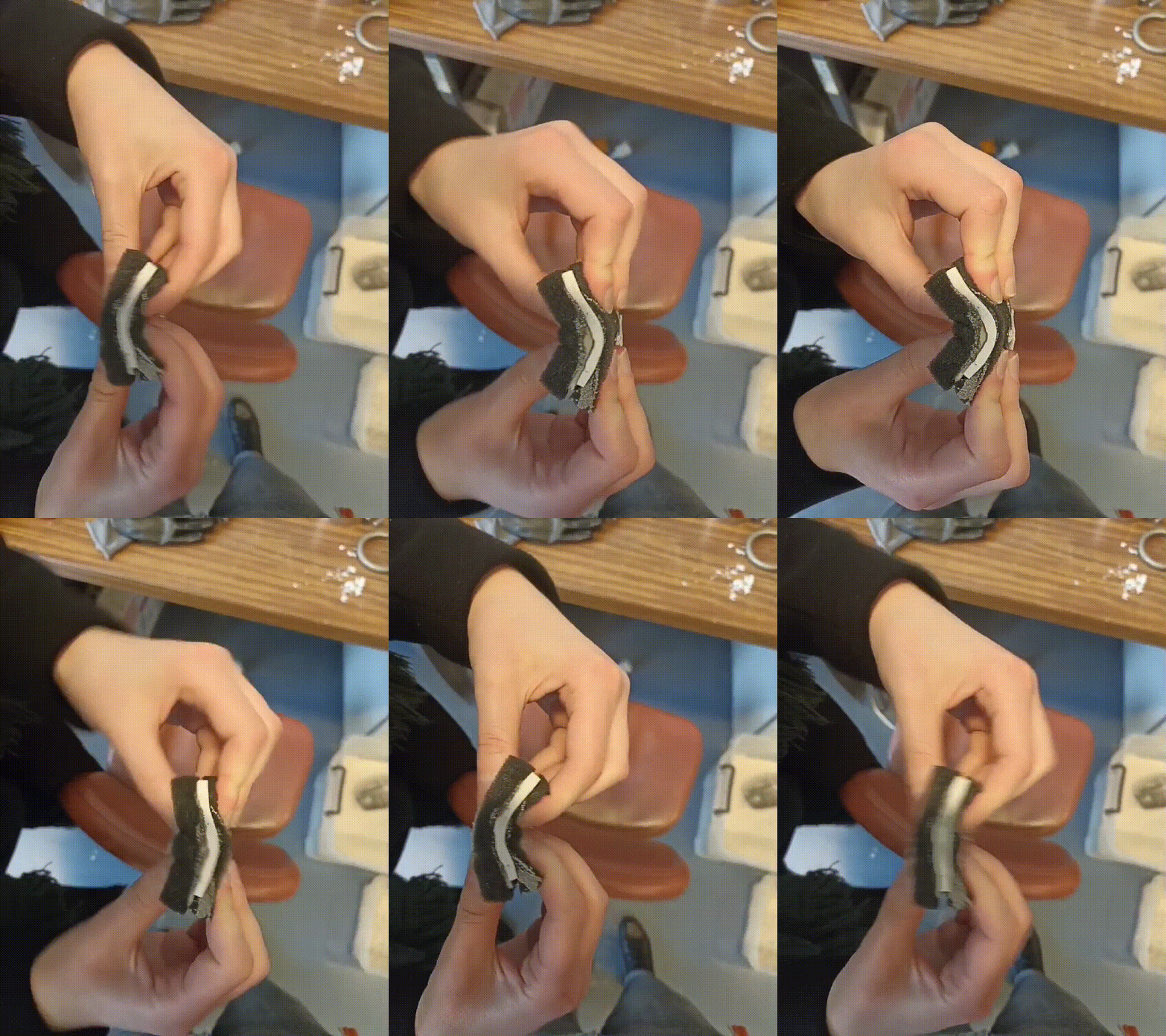
<span style="color: rgb(0, 0, 0);">Le talc a bien fonctionné, il n'y a pas de gradient de silicone dans la mousse. Cela permet de vraiment bien coller la couche de silicone et les mousses sans décollement. Cela fonctionne relativement bien, mais nous ne pouvons pas faire plus de 2 plis (et pour 2 plis, seul Claudio a réussi, nous on n'est pas assez fortes pour faire plus d'un seul pli). Claudio propose d'essayer, pour un 2ème prototype, un silicone moins visqueux. </span>

<span style="color: rgb(0, 0, 0);">[![image.png](https://wiki.fablab.sorbonne-universite.fr/BookStack/uploads/images/gallery/2025-05/scaled-1680-/axEimage.png)](https://wiki.fablab.sorbonne-universite.fr/BookStack/uploads/images/gallery/2025-05/axEimage.png)</span>

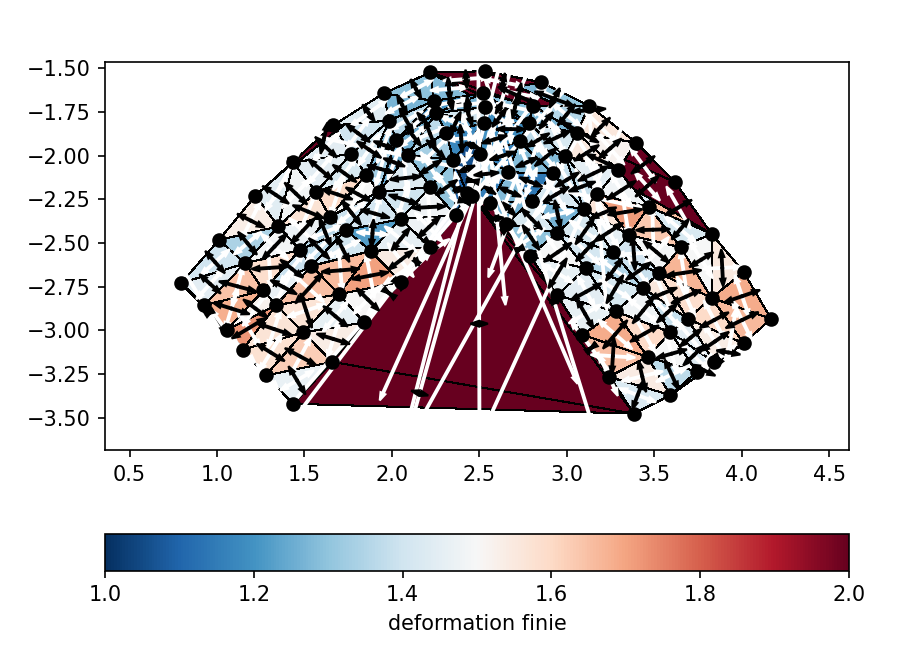
<span style="color: rgb(0, 0, 0);">Avec le quadrillage, on voit qu'il y a plus de déformation au niveau de l'axe du pli que sur les côtés. Maintenant, observons ce que donne le code python : </span><span style="color: rgb(0, 0, 0);"> </span>

<span style="color: rgb(0, 0, 0);">[![test2.png](https://wiki.fablab.sorbonne-universite.fr/BookStack/uploads/images/gallery/2025-05/scaled-1680-/piLtest2.png)](https://wiki.fablab.sorbonne-universite.fr/BookStack/uploads/images/gallery/2025-05/piLtest2.png)</span>

<span style="color: rgb(0, 0, 0);">On a ici une représentation par triangulation (de Delaunay) de la translation et de la déformation entre le prototype non plissé et le prototype plissé. Les flèches noires et blanches indiquent les sens de raccourcissement et d'allongement respectivement. Le gradient de couleur représente quand à lui la vitesse de déformation, donc indique les endroits qui ont été plus affecté par les contraintes. On observe que la déformation est plus importante sur la mousse que sur le silicone (couche centrale), notamment au niveau de la charnière du pli. </span>

<span style="text-decoration: underline; color: rgb(0, 0, 0);">Pour le deuxième modèle :</span>

[![image.png](https://wiki.fablab.sorbonne-universite.fr/BookStack/uploads/images/gallery/2025-05/scaled-1680-/7dhimage.png)](https://wiki.fablab.sorbonne-universite.fr/BookStack/uploads/images/gallery/2025-05/7dhimage.png)

<span style="color: rgb(0, 0, 0);">Nous arrivons à faire plusieurs plis mais le talc a mal fonctionné, il y a un gradient de silicone dans la mousse... De plus, nous avons dû utiliser plus de silicone que prévu (peut-être est-ce dû à ce gradient ? d'erreurs de calculs de notre part, ou de biais physico-chimiques que nous ne maitrisons pas ? de mauvaises données sur le site du vendeur ?) La silicone au fond à par conséquent trop collé à la mousse, nous n'avons pas réussi à bien décoller sans arracher la mousse. Ainsi, problématique de talc ou problématique de silicone ? Conclusion : prototype à améliorer. De plus, le silicone semble plus dur que le premier, il est plus complexe que plisser l'objet car le silicone n'est pas assez souple, mais encore une fois, cela peut être dû au gradient. </span>

<span style="color: rgb(0, 0, 0);">[![image.png](https://wiki.fablab.sorbonne-universite.fr/BookStack/uploads/images/gallery/2025-05/scaled-1680-/v1aimage.png)](https://wiki.fablab.sorbonne-universite.fr/BookStack/uploads/images/gallery/2025-05/v1aimage.png)</span>

Concernant le résultat avec le code informatique, nous observons ceci :

<span style="color: rgb(0, 0, 0);">[![test4.png](https://wiki.fablab.sorbonne-universite.fr/BookStack/uploads/images/gallery/2025-05/scaled-1680-/test4.png)](https://wiki.fablab.sorbonne-universite.fr/BookStack/uploads/images/gallery/2025-05/test4.png)</span>

<span style="color: rgb(0, 0, 0);">On observe ici pour ce modèle qu'il y a plus de déformation, notamment dû au fait que nous avions mis plus de contraintes. Mais cela permet aussi de voir qu'il semble y avoir, encore une fois, moins de déformation au niveau du silicone que de la mousse. Ainsi, le silicone étant plus visqueux que la mousse, il résiste mieux à la contrainte et se déforme moins, ayant pour effet de mettre plus de contraintes (pour équilibrer) sur sa matrice, ici la mousse, qui se déforme ainsi plus distinctement. D'ailleurs, dans les deux modèles, on peut même observer qu'il semblerait y avoir plus de déformations sur la mousse proche du silicone, confirmant cette théorie. </span>

#### <span style="color: rgb(0, 0, 0);">Ce qui peut être amélioré</span>

- <span style="color: rgb(0, 0, 0);">Il serait intéressant de trouver quelque chose pour stabiliser la structure si utilise la structure de haut en bas en longueur et ainsi permettre de plus facilement faire 2 plis de suite, sinon c'est compliqué de créer une contrainte suffisante avec seulement notre propre force personnelle</span>
- <span style="color: rgb(0, 0, 0);">La colle ne fonctionne pas sur la mousse, ou pas longtemps, trouver une autre solution</span>
- <span style="color: rgb(0, 0, 0);">Trouver quelque chose pour éviter le gradient produit par certains silicones (le talc n'ayant pas suffit pour le modèle 2) -&gt; peut-être reprendre les silicones de Esprit Composite répondant mieux au talc . </span>
- <span style="color: rgb(0, 0, 0);">Peut-être créer un modèle moins haut ? faire une couche de silicone moins épaisse (c'est compliqué cependant, au moment du coulage du silicone)</span>

#### <span style="color: rgb(0, 0, 0);">Bibliographie</span>

- <span style="color: rgb(0, 0, 0);">Claudio Rosenberg (2024) - Cours de Tectonique de Licence 2 de Géosciences à Sorbonne Université</span>
- <span style="color: rgb(0, 0, 0);">Loïc Labrousse, Philippe Yamato (2024) - *La déformation des roches, De l'analyse structurale à la définition mécanique de la lithosphère* - Collection Sciences Sup, Edition Dunod</span>
- <span style="color: rgb(0, 0, 0);">Janos Urai, Markus Beckers, Michael Ketterman, Dennis Laux (2010) - *Folding of a single, thick silicone layer (Structural Geology, analogue modelling)* :<span style="font-size: 11pt; font-family: Arial,sans-serif; color: #000000; background-color: transparent; font-weight: 400; font-style: normal; font-variant: normal; text-decoration: none; vertical-align: baseline; white-space: pre-wrap;"> <span style="text-decoration: none;"><span style="font-size: 11pt; font-family: Arial, sans-serif; background-color: transparent; font-weight: 400; font-style: normal; font-variant: normal; text-decoration: underline; text-decoration-skip-ink: none; vertical-align: baseline; white-space: pre-wrap;">[https://youtu.be/jd3hG2PNdUo?si=tqjAjx20PR8gEWnk](https://youtu.be/jd3hG2PNdUo?si=tqjAjx20PR8gEWnk) </span></span></span></span>
- <span style="color: rgb(0, 0, 0);"><span style="font-size: 11pt; font-family: Arial, sans-serif; background-color: transparent; font-weight: 400; font-style: normal; font-variant: normal; text-decoration: none; vertical-align: baseline; white-space: pre-wrap;">Abe, Steffen, et Janos L. Urai. « Discrete Element Modeling of Boudinage: Insights on Rock Rheology, Matrix Flow, and Evolution of Geometry ». </span><span style="font-size: 11pt; font-family: Arial, sans-serif; background-color: transparent; font-weight: 400; font-style: italic; font-variant: normal; text-decoration: none; vertical-align: baseline; white-space: pre-wrap;">Journal of Geophysical Research: Solid Earth</span><span style="font-size: 11pt; font-family: Arial, sans-serif; background-color: transparent; font-weight: 400; font-style: normal; font-variant: normal; text-decoration: none; vertical-align: baseline; white-space: pre-wrap;">, vol. 117, n</span><span style="font-size: 11pt; font-family: Arial, sans-serif; background-color: transparent; font-weight: 400; font-style: normal; font-variant: normal; text-decoration: none; vertical-align: baseline; white-space: pre-wrap;"><span style="font-size: 0.6em; vertical-align: super;">o</span></span><span style="font-size: 11pt; font-family: Arial, sans-serif; background-color: transparent; font-weight: 400; font-style: normal; font-variant: normal; text-decoration: none; vertical-align: baseline; white-space: pre-wrap;"> B1, janvier 2012, p. 2011JB008555. </span><span style="font-size: 11pt; font-family: Arial, sans-serif; background-color: transparent; font-weight: 400; font-style: italic; font-variant: normal; text-decoration: none; vertical-align: baseline; white-space: pre-wrap;">DOI.org (Crossref)</span><span style="font-size: 11pt; font-family: Arial, sans-serif; background-color: transparent; font-weight: 400; font-style: normal; font-variant: normal; text-decoration: none; vertical-align: baseline; white-space: pre-wrap;">, </span><span style="font-size: 11pt; font-family: Arial, sans-serif; background-color: transparent; font-weight: 400; font-style: normal; font-variant: normal; text-decoration: underline; text-decoration-skip-ink: none; vertical-align: baseline; white-space: pre-wrap;">[https://doi.org/10.1029/2011JB008555](https://doi.org/10.1029/2011JB008555)</span><span style="font-size: 11pt; font-family: Arial, sans-serif; background-color: transparent; font-weight: 400; font-style: normal; font-variant: normal; text-decoration: none; vertical-align: baseline; white-space: pre-wrap;">.</span></span>
- <span style="color: rgb(0, 0, 0);"><span style="font-size: 11pt; font-family: Arial, sans-serif; background-color: transparent; font-weight: 400; font-style: normal; font-variant: normal; text-decoration: none; vertical-align: baseline; white-space: pre-wrap;">Bons, Paul D., et Janos L. Urai. « An Apparatus to Experimentally Model the Dynamics of Ductile Shear Zones ». </span><span style="font-size: 11pt; font-family: Arial, sans-serif; background-color: transparent; font-weight: 400; font-style: italic; font-variant: normal; text-decoration: none; vertical-align: baseline; white-space: pre-wrap;">Tectonophysics</span><span style="font-size: 11pt; font-family: Arial, sans-serif; background-color: transparent; font-weight: 400; font-style: normal; font-variant: normal; text-decoration: none; vertical-align: baseline; white-space: pre-wrap;">, vol. 256, n</span><span style="font-size: 11pt; font-family: Arial, sans-serif; background-color: transparent; font-weight: 400; font-style: normal; font-variant: normal; text-decoration: none; vertical-align: baseline; white-space: pre-wrap;"><span style="font-size: 0.6em; vertical-align: super;">o</span></span><span style="font-size: 11pt; font-family: Arial, sans-serif; background-color: transparent; font-weight: 400; font-style: normal; font-variant: normal; text-decoration: none; vertical-align: baseline; white-space: pre-wrap;"> 1‑4, mai 1996, p. 145‑64. </span><span style="font-size: 11pt; font-family: Arial, sans-serif; background-color: transparent; font-weight: 400; font-style: italic; font-variant: normal; text-decoration: none; vertical-align: baseline; white-space: pre-wrap;">DOI.org (Crossref)</span><span style="font-size: 11pt; font-family: Arial, sans-serif; background-color: transparent; font-weight: 400; font-style: normal; font-variant: normal; text-decoration: none; vertical-align: baseline; white-space: pre-wrap;">, </span>[<span style="font-size: 11pt; font-family: Arial, sans-serif; background-color: transparent; font-weight: 400; font-style: normal; font-variant: normal; text-decoration: underline; text-decoration-skip-ink: none; vertical-align: baseline; white-space: pre-wrap;">https://doi.org/10.1016/0040-1951(95)00161-1 </span>](https://doi.org/10.1016/0040-1951(95)00161-1)<span style="font-size: 11pt; font-family: Arial, sans-serif; background-color: transparent; font-weight: 400; font-style: normal; font-variant: normal; text-decoration: none; vertical-align: baseline; white-space: pre-wrap;"> </span></span>
- <span style="color: rgb(0, 0, 0);"><span style="font-size: 11pt; font-family: Arial, sans-serif; background-color: transparent; font-weight: 400; font-style: normal; font-variant: normal; text-decoration: none; vertical-align: baseline; white-space: pre-wrap;">Livio, Franz, et al. « Growth of Bending-Moment Faults Due to Progressive Folding: Insights from Sandbox Models and Paleoseismological Implications ». </span><span style="font-size: 11pt; font-family: Arial, sans-serif; background-color: transparent; font-weight: 400; font-style: italic; font-variant: normal; text-decoration: none; vertical-align: baseline; white-space: pre-wrap;">Geomorphology</span><span style="font-size: 11pt; font-family: Arial, sans-serif; background-color: transparent; font-weight: 400; font-style: normal; font-variant: normal; text-decoration: none; vertical-align: baseline; white-space: pre-wrap;">, vol. 326, février 2019, p. 152‑66. </span><span style="font-size: 11pt; font-family: Arial, sans-serif; background-color: transparent; font-weight: 400; font-style: italic; font-variant: normal; text-decoration: none; vertical-align: baseline; white-space: pre-wrap;">DOI.org (Crossref)</span><span style="font-size: 11pt; font-family: Arial, sans-serif; background-color: transparent; font-weight: 400; font-style: normal; font-variant: normal; text-decoration: none; vertical-align: baseline; white-space: pre-wrap;">, </span><span style="font-size: 11pt; font-family: Arial, sans-serif; background-color: transparent; font-weight: 400; font-style: normal; font-variant: normal; text-decoration: underline; text-decoration-skip-ink: none; vertical-align: baseline; white-space: pre-wrap;">[https://doi.org/10.1016/j.geomorph.2018.02.012](https://doi.org/10.1016/j.geomorph.2018.02.012)</span><span style="font-size: 11pt; font-family: Arial, sans-serif; background-color: transparent; font-weight: 400; font-style: normal; font-variant: normal; text-decoration: none; vertical-align: baseline; white-space: pre-wrap;">.</span></span>
- <span style="color: rgb(0, 0, 0);"><span style="font-size: 11pt; font-family: Arial, sans-serif; background-color: transparent; font-weight: 400; font-style: normal; font-variant: normal; text-decoration: none; vertical-align: baseline; white-space: pre-wrap;">Poulet, M. « Apport des expériences de mécaniques des roches à la géologie structurale des bassins sédimentaires ». </span><span style="font-size: 11pt; font-family: Arial, sans-serif; background-color: transparent; font-weight: 400; font-style: italic; font-variant: normal; text-decoration: none; vertical-align: baseline; white-space: pre-wrap;">Revue de l’Institut Français du Pétrole</span><span style="font-size: 11pt; font-family: Arial, sans-serif; background-color: transparent; font-weight: 400; font-style: normal; font-variant: normal; text-decoration: none; vertical-align: baseline; white-space: pre-wrap;">, vol. 31, n</span><span style="font-size: 11pt; font-family: Arial, sans-serif; background-color: transparent; font-weight: 400; font-style: normal; font-variant: normal; text-decoration: none; vertical-align: baseline; white-space: pre-wrap;"><span style="font-size: 0.6em; vertical-align: super;">o</span></span><span style="font-size: 11pt; font-family: Arial, sans-serif; background-color: transparent; font-weight: 400; font-style: normal; font-variant: normal; text-decoration: none; vertical-align: baseline; white-space: pre-wrap;"> 5, septembre 1976, p. 781‑822. </span><span style="font-size: 11pt; font-family: Arial, sans-serif; background-color: transparent; font-weight: 400; font-style: italic; font-variant: normal; text-decoration: none; vertical-align: baseline; white-space: pre-wrap;">DOI.org (Crossref)</span><span style="font-size: 11pt; font-family: Arial, sans-serif; background-color: transparent; font-weight: 400; font-style: normal; font-variant: normal; text-decoration: none; vertical-align: baseline; white-space: pre-wrap;">, </span><span style="text-decoration: underline; color: rgb(0, 0, 0); font-size: 11pt; font-family: Arial, sans-serif; background-color: transparent; font-weight: 400; font-style: normal; font-variant: normal; text-decoration-skip-ink: none; vertical-align: baseline; white-space: pre-wrap;">[https://doi.org/10.2516/ogst:1976026](https://doi.org/10.2516/ogst:1976026)</span><span style="font-size: 11pt; font-family: Arial, sans-serif; background-color: transparent; font-weight: 400; font-style: normal; font-variant: normal; text-decoration: none; vertical-align: baseline; white-space: pre-wrap;">.</span></span>

#### <span style="color: rgb(0, 0, 0);">Journal de Bord</span>

<details id="bkmrk-%C2%A0-%C2%A0-24-janvier-2025%C2%A0"><summary>24 Janvier 2025</summary>

<span style="color: rgb(0, 0, 0);"><span style="text-decoration: underline;">Explication du Projet</span> : Modélisation de plis à partir de 3 couches de 2 viscosités différentes (afin de déterminer des longueurs d'onde en fonction des différences de viscosité) telle que :   
</span>

<span style="color: rgb(0, 0, 0);">[![image.png](https://wiki.fablab.sorbonne-universite.fr/BookStack/uploads/images/gallery/2025-01/scaled-1680-/fp2image.png)](https://wiki.fablab.sorbonne-universite.fr/BookStack/uploads/images/gallery/2025-01/fp2image.png)</span>

<span style="text-decoration: underline; color: rgb(0, 0, 0);"><span style="font-size: 11pt; font-family: Arial, sans-serif; background-color: transparent; font-weight: 400; font-style: normal; font-variant: normal; vertical-align: baseline; white-space: pre-wrap;">Idées Hypothèse 1 :</span></span>

- <span style="font-size: 11pt; font-family: Arial,sans-serif; color: #000000; background-color: transparent; font-weight: 400; font-style: normal; font-variant: normal; text-decoration: none; vertical-align: baseline; white-space: pre-wrap;">Coudre 2 types de mousses entre elles</span>
- <span style="font-size: 11pt; font-family: Arial,sans-serif; color: #000000; background-color: transparent; font-weight: 400; font-style: normal; font-variant: normal; text-decoration: none; vertical-align: baseline; white-space: pre-wrap;">Utiliser 1 couche de silicone entre 2 couches de mousses différentes</span>
- <span style="font-size: 11pt; font-family: Arial,sans-serif; color: #000000; background-color: transparent; font-weight: 400; font-style: normal; font-variant: normal; text-decoration: none; vertical-align: baseline; white-space: pre-wrap;">Utiliser 4 couches de silicone avec 2 viscosités différentes</span>
- <span style="font-size: 11pt; font-family: Arial,sans-serif; color: #000000; background-color: transparent; font-weight: 400; font-style: normal; font-variant: normal; text-decoration: none; vertical-align: baseline; white-space: pre-wrap;">Utiliser une résine qui rentrerait dans la mousse poreuse - mais attention à ne pas créer de gradient</span>

<span style="text-decoration: underline; color: rgb(0, 0, 0);"><span style="font-size: 11pt; font-family: Arial, sans-serif; background-color: transparent; font-weight: 400; font-style: normal; font-variant: normal; vertical-align: baseline; white-space: pre-wrap;">Références données par Claudio :</span></span>

- <span style="font-size: 11pt; font-family: Arial,sans-serif; color: #000000; background-color: transparent; font-weight: 400; font-style: normal; font-variant: normal; text-decoration: none; vertical-align: baseline; white-space: pre-wrap;">Janos Urai -&gt; Aachen = Aix-La-Chapelle -&gt; Rwth</span>

<span style="text-decoration: underline; color: rgb(0, 0, 0);"><span style="font-size: 11pt; font-family: Arial, sans-serif; background-color: transparent; font-weight: 400; font-style: normal; font-variant: normal; vertical-align: baseline; white-space: pre-wrap;">Vidéos trouvées :</span></span>

- <span style="font-size: 11pt; font-family: Arial,sans-serif; color: #000000; background-color: transparent; font-weight: 400; font-style: normal; font-variant: normal; text-decoration: none; vertical-align: baseline; white-space: pre-wrap;">[<span style="text-decoration: none;"><span style="font-size: 11pt; font-family: Arial, sans-serif; background-color: transparent; font-weight: 400; font-style: normal; font-variant: normal; text-decoration: underline; text-decoration-skip-ink: none; vertical-align: baseline; white-space: pre-wrap;">https://youtu.be/jd3hG2PNdUo?si=tqjAjx20PR8gEWnk</span></span>](https://youtu.be/jd3hG2PNdUo?si=tqjAjx20PR8gEWnk)</span>
- <span style="font-size: 11pt; font-family: Arial,sans-serif; color: #000000; background-color: transparent; font-weight: 400; font-style: normal; font-variant: normal; text-decoration: none; vertical-align: baseline; white-space: pre-wrap;">[<span style="text-decoration: none;"><span style="font-size: 11pt; font-family: Arial, sans-serif; background-color: transparent; font-weight: 400; font-style: normal; font-variant: normal; text-decoration: underline; text-decoration-skip-ink: none; vertical-align: baseline; white-space: pre-wrap;">https://youtu.be/qOtdn8nt1RA?si=KTQ1f967trydSD3a</span></span>](https://youtu.be/qOtdn8nt1RA?si=KTQ1f967trydSD3a)</span>

<span style="color: rgb(0, 0, 0);"><span style="font-size: 11pt; font-family: Arial, sans-serif; background-color: transparent; font-weight: 400; font-style: normal; font-variant: normal; text-decoration: none; vertical-align: baseline; white-space: pre-wrap;">“Pliage d'une couche de </span><span style="font-size: 11pt; font-family: Arial, sans-serif; background-color: transparent; font-weight: bold; font-style: normal; font-variant: normal; text-decoration: underline; text-decoration-skip-ink: none; vertical-align: baseline; white-space: pre-wrap;">silicone unique et épaisse</span><span style="font-size: 11pt; font-family: Arial, sans-serif; background-color: transparent; font-weight: 400; font-style: normal; font-variant: normal; text-decoration: none; vertical-align: baseline; white-space: pre-wrap;">, intégrée dans une </span><span style="font-size: 11pt; font-family: Arial, sans-serif; background-color: transparent; font-weight: bold; font-style: normal; font-variant: normal; text-decoration: underline; text-decoration-skip-ink: none; vertical-align: baseline; white-space: pre-wrap;">matrice de mousse isolante</span><span style="font-size: 11pt; font-family: Arial, sans-serif; background-color: transparent; font-weight: 400; font-style: normal; font-variant: normal; text-decoration: none; vertical-align: baseline; white-space: pre-wrap;">. Cette playlist présente quelques films sur le pliage analogique de couches de silicone intégrées dans une matrice de mousse. Nous avons construit ces modèles pour démontrer le pliage d'une et de plusieurs couches dans des roches en classe, en suivant plus ou moins les figures du </span><span style="font-size: 11pt; font-family: Arial, sans-serif; background-color: transparent; font-weight: bold; font-style: normal; font-variant: normal; text-decoration: underline; text-decoration-skip-ink: none; vertical-align: baseline; white-space: pre-wrap;">livre de John Ramsay.</span><span style="font-size: 11pt; font-family: Arial, sans-serif; background-color: transparent; font-weight: 400; font-style: normal; font-variant: normal; text-decoration: none; vertical-align: baseline; white-space: pre-wrap;"> Ils sont suffisamment grands pour être utilisés en classe, assez légers et peuvent être déformés à la main devant la classe. Ils peuvent être réutilisés. Nous avons utilisé des élastomères compressibles plutôt que des matériaux visqueux pour obtenir le bon effet, car cela permet de modifier le volume et même de former une sorte de clivage dans le plan axial. Si l'intérêt est suffisant, nous pourrions envisager d'offrir ces modèles sous la forme d'un kit d'enseignement et de demander à une entreprise de produire un lot”</span></span>

<span style="font-size: 11pt; font-family: Arial,sans-serif; color: #000000; background-color: transparent; font-weight: 400; font-style: normal; font-variant: normal; text-decoration: none; vertical-align: baseline; white-space: pre-wrap;"><span style="text-decoration: underline;">Articles de Janos Urai pouvant être intéressants :</span></span>

- <span style="color: rgb(0, 0, 0);"><span style="font-size: 11pt; font-family: Arial, sans-serif; background-color: transparent; font-weight: 400; font-style: normal; font-variant: normal; text-decoration: none; vertical-align: baseline; white-space: pre-wrap;">Abe, Steffen, et Janos L. Urai. « Discrete Element Modeling of Boudinage: Insights on Rock Rheology, Matrix Flow, and Evolution of Geometry ». </span><span style="font-size: 11pt; font-family: Arial, sans-serif; background-color: transparent; font-weight: 400; font-style: italic; font-variant: normal; text-decoration: none; vertical-align: baseline; white-space: pre-wrap;">Journal of Geophysical Research: Solid Earth</span><span style="font-size: 11pt; font-family: Arial, sans-serif; background-color: transparent; font-weight: 400; font-style: normal; font-variant: normal; text-decoration: none; vertical-align: baseline; white-space: pre-wrap;">, vol. 117, n</span><span style="font-size: 11pt; font-family: Arial, sans-serif; background-color: transparent; font-weight: 400; font-style: normal; font-variant: normal; text-decoration: none; vertical-align: baseline; white-space: pre-wrap;"><span style="font-size: 0.6em; vertical-align: super;">o</span></span><span style="font-size: 11pt; font-family: Arial, sans-serif; background-color: transparent; font-weight: 400; font-style: normal; font-variant: normal; text-decoration: none; vertical-align: baseline; white-space: pre-wrap;"> B1, janvier 2012, p. 2011JB008555. </span><span style="font-size: 11pt; font-family: Arial, sans-serif; background-color: transparent; font-weight: 400; font-style: italic; font-variant: normal; text-decoration: none; vertical-align: baseline; white-space: pre-wrap;">DOI.org (Crossref)</span><span style="font-size: 11pt; font-family: Arial, sans-serif; background-color: transparent; font-weight: 400; font-style: normal; font-variant: normal; text-decoration: none; vertical-align: baseline; white-space: pre-wrap;">, </span>[<span style="font-size: 11pt; font-family: Arial, sans-serif; background-color: transparent; font-weight: 400; font-style: normal; font-variant: normal; text-decoration: underline; text-decoration-skip-ink: none; vertical-align: baseline; white-space: pre-wrap;">https://doi.org/10.1029/2011JB008555</span>](https://doi.org/10.1029/2011JB008555)<span style="font-size: 11pt; font-family: Arial, sans-serif; background-color: transparent; font-weight: 400; font-style: normal; font-variant: normal; text-decoration: none; vertical-align: baseline; white-space: pre-wrap;">.</span></span>
- <span style="color: rgb(0, 0, 0);"><span style="font-size: 11pt; font-family: Arial, sans-serif; background-color: transparent; font-weight: 400; font-style: normal; font-variant: normal; text-decoration: none; vertical-align: baseline; white-space: pre-wrap;">Bons, Paul D., et Janos L. Urai. « An Apparatus to Experimentally Model the Dynamics of Ductile Shear Zones ». </span><span style="font-size: 11pt; font-family: Arial, sans-serif; background-color: transparent; font-weight: 400; font-style: italic; font-variant: normal; text-decoration: none; vertical-align: baseline; white-space: pre-wrap;">Tectonophysics</span><span style="font-size: 11pt; font-family: Arial, sans-serif; background-color: transparent; font-weight: 400; font-style: normal; font-variant: normal; text-decoration: none; vertical-align: baseline; white-space: pre-wrap;">, vol. 256, n</span><span style="font-size: 11pt; font-family: Arial, sans-serif; background-color: transparent; font-weight: 400; font-style: normal; font-variant: normal; text-decoration: none; vertical-align: baseline; white-space: pre-wrap;"><span style="font-size: 0.6em; vertical-align: super;">o</span></span><span style="font-size: 11pt; font-family: Arial, sans-serif; background-color: transparent; font-weight: 400; font-style: normal; font-variant: normal; text-decoration: none; vertical-align: baseline; white-space: pre-wrap;"> 1‑4, mai 1996, p. 145‑64. </span><span style="font-size: 11pt; font-family: Arial, sans-serif; background-color: transparent; font-weight: 400; font-style: italic; font-variant: normal; text-decoration: none; vertical-align: baseline; white-space: pre-wrap;">DOI.org (Crossref)</span><span style="font-size: 11pt; font-family: Arial, sans-serif; background-color: transparent; font-weight: 400; font-style: normal; font-variant: normal; text-decoration: none; vertical-align: baseline; white-space: pre-wrap;">, </span>[<span style="font-size: 11pt; font-family: Arial, sans-serif; background-color: transparent; font-weight: 400; font-style: normal; font-variant: normal; text-decoration: underline; text-decoration-skip-ink: none; vertical-align: baseline; white-space: pre-wrap;">https://doi.org/10.1016/0040-1951(95)00161-1</span>](https://doi.org/10.1016/0040-1951(95)00161-1)<span style="font-size: 11pt; font-family: Arial, sans-serif; background-color: transparent; font-weight: 400; font-style: normal; font-variant: normal; text-decoration: none; vertical-align: baseline; white-space: pre-wrap;">.</span></span>
- <span style="color: rgb(0, 0, 0);"><span style="font-size: 11pt; font-family: Arial, sans-serif; background-color: transparent; font-weight: 400; font-style: normal; font-variant: normal; text-decoration: none; vertical-align: baseline; white-space: pre-wrap;">Livio, Franz, et al. « Growth of Bending-Moment Faults Due to Progressive Folding: Insights from Sandbox Models and Paleoseismological Implications ». </span><span style="font-size: 11pt; font-family: Arial, sans-serif; background-color: transparent; font-weight: 400; font-style: italic; font-variant: normal; text-decoration: none; vertical-align: baseline; white-space: pre-wrap;">Geomorphology</span><span style="font-size: 11pt; font-family: Arial, sans-serif; background-color: transparent; font-weight: 400; font-style: normal; font-variant: normal; text-decoration: none; vertical-align: baseline; white-space: pre-wrap;">, vol. 326, février 2019, p. 152‑66. </span><span style="font-size: 11pt; font-family: Arial, sans-serif; background-color: transparent; font-weight: 400; font-style: italic; font-variant: normal; text-decoration: none; vertical-align: baseline; white-space: pre-wrap;">DOI.org (Crossref)</span><span style="font-size: 11pt; font-family: Arial, sans-serif; background-color: transparent; font-weight: 400; font-style: normal; font-variant: normal; text-decoration: none; vertical-align: baseline; white-space: pre-wrap;">, </span>[<span style="font-size: 11pt; font-family: Arial, sans-serif; background-color: transparent; font-weight: 400; font-style: normal; font-variant: normal; text-decoration: underline; text-decoration-skip-ink: none; vertical-align: baseline; white-space: pre-wrap;">https://doi.org/10.1016/j.geomorph.2018.02.012</span>](https://doi.org/10.1016/j.geomorph.2018.02.012)<span style="font-size: 11pt; font-family: Arial, sans-serif; background-color: transparent; font-weight: 400; font-style: normal; font-variant: normal; text-decoration: none; vertical-align: baseline; white-space: pre-wrap;">.</span></span>

<span style="text-decoration: underline; color: rgb(0, 0, 0);"><span style="font-size: 11pt; font-family: Arial, sans-serif; background-color: transparent; font-weight: 400; font-style: normal; font-variant: normal; vertical-align: baseline; white-space: pre-wrap;">Autres articles intéressants possiblement</span></span>

- <span style="color: rgb(0, 0, 0);"><span style="font-size: 11pt; font-family: Arial, sans-serif; background-color: transparent; font-weight: 400; font-style: normal; font-variant: normal; text-decoration: none; vertical-align: baseline; white-space: pre-wrap;">Poulet, M. « Apport des expériences de mécaniques des roches à la géologie structurale des bassins sédimentaires ». </span><span style="font-size: 11pt; font-family: Arial, sans-serif; background-color: transparent; font-weight: 400; font-style: italic; font-variant: normal; text-decoration: none; vertical-align: baseline; white-space: pre-wrap;">Revue de l’Institut Français du Pétrole</span><span style="font-size: 11pt; font-family: Arial, sans-serif; background-color: transparent; font-weight: 400; font-style: normal; font-variant: normal; text-decoration: none; vertical-align: baseline; white-space: pre-wrap;">, vol. 31, n</span><span style="font-size: 11pt; font-family: Arial, sans-serif; background-color: transparent; font-weight: 400; font-style: normal; font-variant: normal; text-decoration: none; vertical-align: baseline; white-space: pre-wrap;"><span style="font-size: 0.6em; vertical-align: super;">o</span></span><span style="font-size: 11pt; font-family: Arial, sans-serif; background-color: transparent; font-weight: 400; font-style: normal; font-variant: normal; text-decoration: none; vertical-align: baseline; white-space: pre-wrap;"> 5, septembre 1976, p. 781‑822. </span><span style="font-size: 11pt; font-family: Arial, sans-serif; background-color: transparent; font-weight: 400; font-style: italic; font-variant: normal; text-decoration: none; vertical-align: baseline; white-space: pre-wrap;">DOI.org (Crossref)</span><span style="font-size: 11pt; font-family: Arial, sans-serif; background-color: transparent; font-weight: 400; font-style: normal; font-variant: normal; text-decoration: none; vertical-align: baseline; white-space: pre-wrap;">, </span>[<span style="font-size: 11pt; font-family: Arial, sans-serif; background-color: transparent; font-weight: 400; font-style: normal; font-variant: normal; text-decoration: underline; text-decoration-skip-ink: none; vertical-align: baseline; white-space: pre-wrap;">https://doi.org/10.2516/ogst:1976026</span>](https://doi.org/10.2516/ogst:1976026)<span style="font-size: 11pt; font-family: Arial, sans-serif; background-color: transparent; font-weight: 400; font-style: normal; font-variant: normal; text-decoration: none; vertical-align: baseline; white-space: pre-wrap;">.</span></span>

</details><details id="bkmrk-31-janvier-2025-nous"><summary>31 Janvier 2025</summary>

- <span style="color: rgb(0, 0, 0);">Nous avons contacté Markus Beckers, un ancien collègue de Janos Urai, pour avoir plus d'informations sur leur modélisation de plis utilisant le silicone et les mousses.</span>
- <span style="color: rgb(0, 0, 0);">Nous avons également contacté le responsable de la plateforme Biologie/Chimie du Fablab, Steve Hubert, afin de demander conseil sur les silicones et savoir quand est-ce qu'on peut y avoir accès</span>

<span style="color: rgb(0, 0, 0);">(autres : mousse polyéthylène non réticulée)</span>

<span style="color: rgb(0, 0, 0);"><span style="text-decoration: underline;">Objectifs :</span> </span>

- <span style="color: rgb(0, 0, 0);">Déterminer la taille de mousses</span>
- <span style="color: rgb(0, 0, 0);">Trouver une manière de découper les mousses de façon égales</span>
- <span style="color: rgb(0, 0, 0);">Trouver un milieu pour faire couler du silicone entre les 2 mousses</span>

<span style="color: rgb(0, 0, 0);"><span style="text-decoration: underline;">Expérience :</span> </span>

- <span style="color: rgb(0, 0, 0);">Mousse utilisée : voir photo suivante </span>
- <span style="color: rgb(0, 0, 0);">Taille des mousses : voir schéma suivant - Taille de la couche de silicone : On va choisir 1,5cm d'épaisseur </span>
- <span style="color: rgb(0, 0, 0);">Milieu pour faire couler silicone -&gt; carton que l'on va faire à partir des mesures de la taille des mousses. </span>

<span style="color: rgb(0, 0, 0);">[![MousseUtiliséeenExp1.jpg](https://wiki.fablab.sorbonne-universite.fr/BookStack/uploads/images/gallery/2025-01/scaled-1680-/mousseutiliseeenexp1.jpg) ](https://wiki.fablab.sorbonne-universite.fr/BookStack/uploads/images/gallery/2025-01/mousseutiliseeenexp1.jpg)[![exp1.png](https://wiki.fablab.sorbonne-universite.fr/BookStack/uploads/images/gallery/2025-01/scaled-1680-/exp1.png)](https://wiki.fablab.sorbonne-universite.fr/BookStack/uploads/images/gallery/2025-01/exp1.png)</span>

<span style="color: rgb(0, 0, 0);"> <span style="text-decoration: underline;">Figure 1 :</span> mousse utilisée <span style="text-decoration: underline;">Figure 2 :</span> Schéma des dimensions du "moule" pour les 2 couches de mousses et la couche de silicone </span>

<span style="color: rgb(0, 0, 0);">[![maquette.jpg](https://wiki.fablab.sorbonne-universite.fr/BookStack/uploads/images/gallery/2025-01/scaled-1680-/maquette.jpg)](https://wiki.fablab.sorbonne-universite.fr/BookStack/uploads/images/gallery/2025-01/maquette.jpg)</span>

<span style="color: rgb(0, 0, 0);"><span style="text-decoration: underline;">Figure 3 :</span> le carton (1)</span>

<span style="color: rgb(0, 0, 0);">[![proto1.jpeg](https://wiki.fablab.sorbonne-universite.fr/BookStack/uploads/images/gallery/2025-01/scaled-1680-/proto1.jpeg)](https://wiki.fablab.sorbonne-universite.fr/BookStack/uploads/images/gallery/2025-01/proto1.jpeg)</span>

<span style="color: rgb(0, 0, 0);"><span style="text-decoration: underline;">Figure 4</span><span style="text-decoration: underline;"> :</span> Prototype n°1</span>

- <span style="color: rgb(0, 0, 0);">Construction du prototype de montage du "pli" : 2 mousses de même épaisseur avec un espace de 3 cm entre les 2 (emplacement prévu pour le silicone), découpe de la mousse au FabLab prototypage avec une scie. </span>
- <span style="color: rgb(0, 0, 0);">Visite du FabLab chimie pour tester la fixation de la mousse avec le silicone.</span>

</details><details id="bkmrk-05-f%C3%A9vrier-2025-pass"><summary>05 Février 2025</summary>

<span style="color: rgb(0, 0, 0);">Passage au Fablab Chimie pour observer aller vérifier si le silicone colle / adhère bien à la mousse. Résultat : ça adhère bien. </span>

<span style="color: rgb(0, 0, 0);">Test sur plus grande surface et avec un peu plus de silicone, à récupérer le 07/02</span>

</details>
<details id="bkmrk-07-f%C3%A9vrier-2025-pass"><summary>07 Février 2025</summary>

<span style="color: rgb(0, 0, 0);">Passage au Fablab Chimie pour récupérer le test. Résultat : Silicone adhère bien mais il a coulé. Pour régler cela : colle et talc. Si ça ne fonctionne toujours pas, il faudra trouver un autre type de mousse. </span>

<span style="color: rgb(0, 0, 0);"> [![Test1 Silicone.PNG](https://wiki.fablab.sorbonne-universite.fr/BookStack/uploads/images/gallery/2025-02/scaled-1680-/test1-silicone.PNG)](https://wiki.fablab.sorbonne-universite.fr/BookStack/uploads/images/gallery/2025-02/test1-silicone.PNG) [![test1.1.PNG](https://wiki.fablab.sorbonne-universite.fr/BookStack/uploads/images/gallery/2025-02/scaled-1680-/test1-1.PNG)](https://wiki.fablab.sorbonne-universite.fr/BookStack/uploads/images/gallery/2025-02/test1-1.PNG)</span>

<span style="color: rgb(0, 0, 0);">Recherche sur des mousses moins poreuses et viscosité de différents silicones : </span>

- <span style="color: rgb(0, 0, 0);">Mousse de polyuréthane d'une porosité d'environ 98% dont les pores, d'une taille d'environ trois millimètres, sont fermés par des membranes de 1 à 5 micromètres d'épaisseur. [![RefSilicones.PNG](https://wiki.fablab.sorbonne-universite.fr/BookStack/uploads/images/gallery/2025-02/scaled-1680-/refsilicones.PNG)](https://wiki.fablab.sorbonne-universite.fr/BookStack/uploads/images/gallery/2025-02/refsilicones.PNG)</span>
- <span style="color: rgb(0, 0, 0);">Référence : <span style="text-decoration: underline;">Etude des propriétés rhéologiques et de vulcanisation des élastomères silicones bi-composants</span> - H. OU, M. SAHLI, T. BARRIERE et J.C. GELIN - Institut FEMTO-ST, Département de Mécanique Appliquée, 24 rue de l’Epitaphe, 25000 Besançon, France</span>
- <span style="color: rgb(0, 0, 0);">Silicone RTV-A-2186 = grande élasticité (321%) :[![image.png](https://wiki.fablab.sorbonne-universite.fr/BookStack/uploads/images/gallery/2025-02/scaled-1680-/WPAimage.png)](https://wiki.fablab.sorbonne-universite.fr/BookStack/uploads/images/gallery/2025-02/WPAimage.png) </span>
- <span style="color: rgb(0, 0, 0);">Référence : Polyzois, Gregory L., et al. « An Assessment of the Physical Properties and Biocompatibility of Three Silicone Elastomers ». *The Journal of Prosthetic Dentistry*, vol. 71, n<sup>o</sup> 5, mai 1994, p. 500‑04. *DOI.org (Crossref)*, https://doi.org/10.1016/0022-3913(94)90190-2.</span>

<span style="color: rgb(0, 0, 0);"><span style="text-decoration: underline;">Hypothèse 2 : Mousse expansive et isolante</span> ?</span>

<span style="color: rgb(0, 0, 0);">-&gt; cette hypothèse a été plus ou moins invalidée par le fait que la majorité du temps, les mousses expansives sont très peu souples. </span>

</details><details id="bkmrk-10-f%C3%A9vrier-2025-pass"><summary>10 Février 2025</summary>

<span style="color: rgb(0, 0, 0);">Passage au Fablab Chimie pour observer aller vérifier si le silicone de l'expérimentation avec le talc. Résultat : ça fonctionne bien, </span>

<span style="color: rgb(0, 0, 0);">le silicone rentre moins dans la mousse et ne va pas totalement au fond. </span>

<span style="color: rgb(0, 0, 0);">[ ![10Février.PNG](https://wiki.fablab.sorbonne-universite.fr/BookStack/uploads/images/gallery/2025-02/scaled-1680-/10fevrier.PNG)](https://wiki.fablab.sorbonne-universite.fr/BookStack/uploads/images/gallery/2025-02/10fevrier.PNG)[ ![10FévrierEpisode2.PNG](https://wiki.fablab.sorbonne-universite.fr/BookStack/uploads/images/gallery/2025-02/scaled-1680-/10fevrierepisode2.PNG)](https://wiki.fablab.sorbonne-universite.fr/BookStack/uploads/images/gallery/2025-02/10fevrierepisode2.PNG)</span>

<span style="color: rgb(0, 0, 0);">[![WhatsApp-Video-2025-03-21-at-14.33.23.gif](https://wiki.fablab.sorbonne-universite.fr/BookStack/uploads/images/gallery/2025-03/whatsapp-video-2025-03-21-at-14-33-23.gif)](https://wiki.fablab.sorbonne-universite.fr/BookStack/uploads/images/gallery/2025-03/whatsapp-video-2025-03-21-at-14-33-23.gif)</span>

</details><details id="bkmrk-14-f%C3%A9vrier-2025-id%C3%A9e"><summary>14 Février 2025</summary>

<span style="color: rgb(0, 0, 0);"><span style="text-decoration: underline;">Idées</span> :</span>

<span style="color: rgb(0, 0, 0);"> 0. Envoyer un mail ou aller voir Fablab chimie pour demander si possibilité d'ouverture Fablab chimie jeudi matin + prévoir suffisamment de silicone</span>

1. <span style="color: rgb(0, 0, 0);">Jeudi matin (entre 08h30 et 10h30) : mettre silicone sur le fond</span>
2. <span style="color: rgb(0, 0, 0);">Jeudi après-midi (entre 13h45 et 14h45) : mettre mousse sur silicone en train de se durcir progressivement (pour éviter que la mousse s'enfonce trop)</span>
3. <span style="color: rgb(0, 0, 0);">vendredi : mettre enfin le silicone entre les deux mousses</span>

<span style="color: rgb(0, 0, 0);">[![exp3.PNG](https://wiki.fablab.sorbonne-universite.fr/BookStack/uploads/images/gallery/2025-02/scaled-1680-/exp3.PNG)  ](https://wiki.fablab.sorbonne-universite.fr/BookStack/uploads/images/gallery/2025-02/exp3.PNG)<span style="text-decoration: underline;">Schéma des étapes du montage</span></span>

<span style="color: rgb(0, 0, 0);">Faire le format pour le grand prototype n°1. Il faut vérifier qu'avec une grande taille ça fonctionne avec nos mousses. </span>

<span style="color: rgb(0, 0, 0);">[ ![ousse14Février.PNG](https://wiki.fablab.sorbonne-universite.fr/BookStack/uploads/images/gallery/2025-02/scaled-1680-/ousse14fevrier.PNG)](https://wiki.fablab.sorbonne-universite.fr/BookStack/uploads/images/gallery/2025-02/ousse14fevrier.PNG)[ ![exp3mesures.PNG](https://wiki.fablab.sorbonne-universite.fr/BookStack/uploads/images/gallery/2025-02/scaled-1680-/exp3mesures.PNG)](https://wiki.fablab.sorbonne-universite.fr/BookStack/uploads/images/gallery/2025-02/exp3mesures.PNG)</span>

<span style="color: rgb(0, 0, 0);">Volume <span style="text-decoration: underline;">environnant</span> de silicone utilisé = 1,7\*11,5\*41,8=817,19cm^3 pour la couche de silicone</span>

<span style="color: rgb(0, 0, 0);">Volume <span style="text-decoration: underline;">environnant</span> de silicone utilisé = 0,5\*11,2\*41,8=234,08cm^3 pour la base de silicone en dessous pour que ça colle</span>

<span style="color: rgb(0, 0, 0);">Volume total de silicone utilisé = 1051,27cm^3, on peut anticiper en considérant qu'il en faut 1070cm^3. </span>

<span style="color: rgb(0, 0, 0);">- 1,07L de silicone totalement. </span>

<span style="color: rgb(0, 0, 0);">Notre Silicone = RTV 151, de densité d=1,2 - une viscosité de 8000 mPa.s. </span>

</details><details id="bkmrk-20-f%C3%A9vrier-2025-pass"><summary>20 Février 2025</summary>

<span style="color: rgb(0, 0, 0);">Passage au Fablab Chimie pour faire la base de silicone de 0,5cm (le matin) puis mise des mousses enduites de talc (pour éviter que le silicone rentre dans la mousse) 1h35 plus tard (avec colle sur les côtés carrés - voir schéma). </span>

<span style="color: rgb(0, 0, 0);">[![21Févrierppppp.PNG](https://wiki.fablab.sorbonne-universite.fr/BookStack/uploads/images/gallery/2025-02/scaled-1680-/21fevrierppppp.PNG)](https://wiki.fablab.sorbonne-universite.fr/BookStack/uploads/images/gallery/2025-02/21fevrierppppp.PNG)</span>

<span style="color: rgb(0, 0, 0);">On a m=ρ\*V donc m=1,25(g/cm^3)\*235(cm^3). m=236,25g. On utilise 95% de silicone et 5% de catalyseur. </span>

<span style="color: rgb(0, 0, 0);">0,95\*236,25=224,44g de silicone et 0,05\*236,25=11,81g de catalyseur</span>

</details><details id="bkmrk-21-f%C3%A9vrier-2025-pass"><summary>21 Février 2025</summary>

<span style="color: rgb(0, 0, 0);">Passage au Fablab Chimie pour faire la couche de silicone centrale. On anticipe 820cm^3 de silicone. </span>

<span style="color: rgb(0, 0, 0);">m=ρ\*V donc m=1,25\*820=1025g. On va le faire en 4x car on a un petit conteneur. Ainsi, 1025/4=256,25g</span>

<span style="color: rgb(0, 0, 0);">Pour 256,25g, on a besoin de 0,95\*256,25=243,44g de silicone et 0,05\*256,25=12,81g de catalyseur. </span>

<span style="color: rgb(0, 0, 0);">Pour les 3 premiers quarts, on a bien fait 243,44g de silicone... mais pour le 4ème, nous n'avions plus assez de silicone donc nous avons utilisé 235,89g de silicone, complétés par 12,42g de catalyseur. Nous n'avons pas réussi à terminer la couche de silicone par manque de silicone. Voici le résultat pour le moment : </span>

<span style="color: rgb(0, 0, 0);">[ ![21Février2.PNG](https://wiki.fablab.sorbonne-universite.fr/BookStack/uploads/images/gallery/2025-02/scaled-1680-/21fevrier2.PNG)](https://wiki.fablab.sorbonne-universite.fr/BookStack/uploads/images/gallery/2025-02/21fevrier2.PNG)[ ![21Février.PNG](https://wiki.fablab.sorbonne-universite.fr/BookStack/uploads/images/gallery/2025-02/scaled-1680-/21fevrier.PNG)](https://wiki.fablab.sorbonne-universite.fr/BookStack/uploads/images/gallery/2025-02/21fevrier.PNG)</span>

<span style="color: rgb(0, 0, 0);">Il faut acheter encore du silicone et du catalyseur à silicone. </span>

</details><details id="bkmrk-14-mars-2025-aujourd"><summary>14 Mars 2025</summary>

<span style="text-decoration: underline; color: rgb(0, 0, 0);">[![IMG_20250314_155546.jpg](https://wiki.fablab.sorbonne-universite.fr/BookStack/uploads/images/gallery/2025-03/scaled-1680-/img-20250314-155546.jpg)](https://wiki.fablab.sorbonne-universite.fr/BookStack/uploads/images/gallery/2025-03/img-20250314-155546.jpg)[![IMG20250314155635.jpg](https://wiki.fablab.sorbonne-universite.fr/BookStack/uploads/images/gallery/2025-03/scaled-1680-/img20250314155635.jpg)](https://wiki.fablab.sorbonne-universite.fr/BookStack/uploads/images/gallery/2025-03/img20250314155635.jpg)[![IMG20250314155654.jpg](https://wiki.fablab.sorbonne-universite.fr/BookStack/uploads/images/gallery/2025-03/scaled-1680-/img20250314155654.jpg)](https://wiki.fablab.sorbonne-universite.fr/BookStack/uploads/images/gallery/2025-03/img20250314155654.jpg)</span>
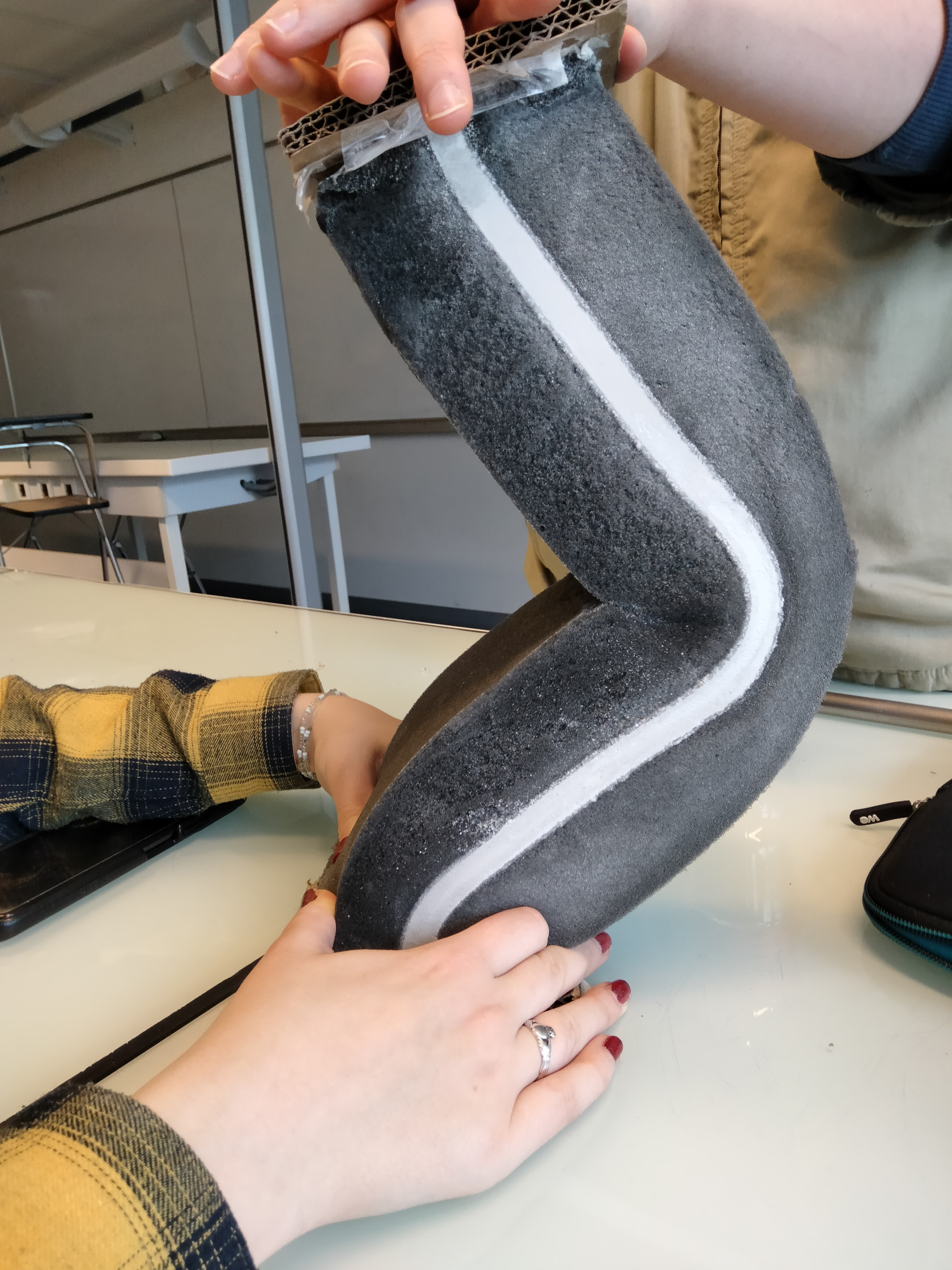
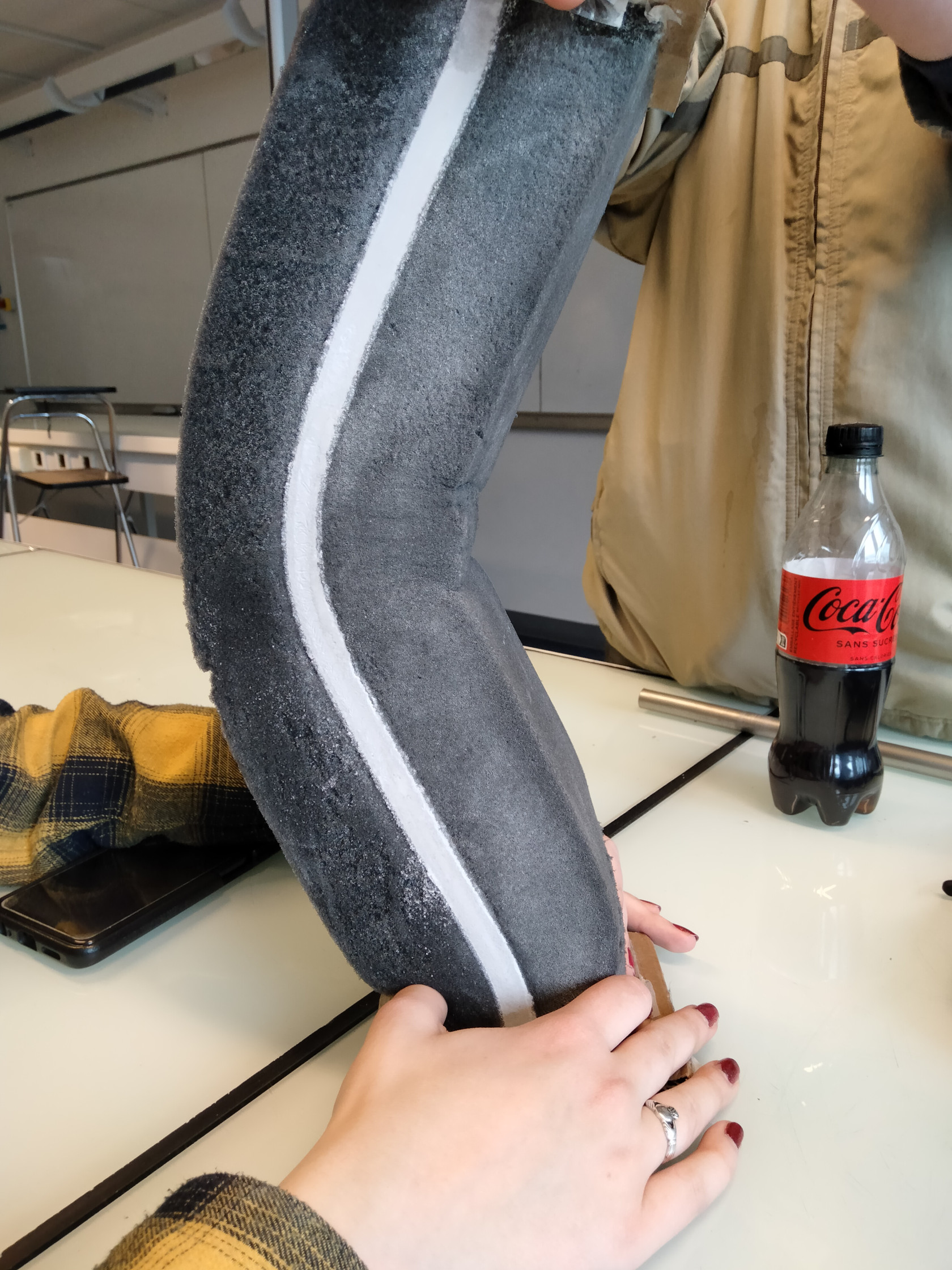
<span style="color: rgb(0, 0, 0);">Aujourd'hui nous sommes allées chercher notre prototype au Fablab chimie. Nous avons découpé 3 faces de carton (le fond et 2 côtés) et le haut de mousse en trop. Nous avons fait des essais de pli en appliquant une force sur le dessus (voir les photos). Ca fonctionne bien. Nous allons refaire un modèle avec une plus grosse épaisseur de mousse (fois 2 ou fois 3) avec peut-être une épaisseur de silicone de 1cm. Les socles en carton se décollent un peu, il faut trouver un moyen de les fixer. </span>

</details><details id="bkmrk-28-mars-2025-recherc"><summary>28 Mars 2025</summary>

<span style="color: rgb(0, 0, 0);">Recherche pour les achats. </span><span style="color: rgb(0, 0, 0);">Pour le silicone : n'importe lequel des 2 silicones suivants : </span><span style="color: rgb(0, 0, 0); background-color: rgb(255, 255, 255);">Silicone RTV 120 - Esprit composite ou Silicone RTV 67 - Esprit composite (car dureté plus faible). Pour les mousses, mousse synthétique à cellules ouvertes, diamètre cellulaire <span style="color: rgb(0, 0, 0); background-color: rgb(255, 255, 255);">~ 1mm (1000 µ) = mousse isolante + Polyuréthane légère et extra-compressible. </span></span>

</details><details id="bkmrk-04-avril-2025-on-a-r"><summary>04 Avril 2025</summary>

<span style="color: rgb(0, 0, 0);">On a reçu le silicone :</span>

[![siliconereçu.jpg](https://wiki.fablab.sorbonne-universite.fr/BookStack/uploads/images/gallery/2025-04/scaled-1680-/siliconerecu.jpg)](https://wiki.fablab.sorbonne-universite.fr/BookStack/uploads/images/gallery/2025-04/siliconerecu.jpg)

</details><details id="bkmrk-11-avril-2025-nous-a"><summary>11 Avril 2025</summary>

<span style="color: rgb(0, 0, 0);">Nous avons construit le "moule" pour notre deuxième prototype et découpé la mousse.</span>

<span style="color: rgb(0, 0, 0);">Nos deux plaques de mousses ont des dimensions plus grandes que celles du premier prototype : 64 cm x 4 cm x 22 cm. Nous visons aussi une dimension de silicone différente : le fond fera toujours 0.5 cm de hauteur mais la couche entre les 2 mousses devrait faire : 64 cm x 1.2 cm x 22 cm.</span>

<span style="color: rgb(0, 0, 0);">Comme l'espace biologie-chimie était fermé nous en avons profité pour effectuer les calculs préliminaires pour couler le silicone :</span>

<span style="color: rgb(0, 0, 0);">Volume <span style="text-decoration: underline;">environnant</span> de silicone utilisé = 64\*1.2\*22 = 1690 cm^3 pour la couche centrale de silicone</span>

<span style="color: rgb(0, 0, 0);">Volume <span style="text-decoration: underline;">environnant</span> de silicone utilisé = 0.5\*(4+4+1.2)\*64 = 295 cm^3 pour la base de silicone en dessous pour que ça colle</span>

<span style="color: rgb(0, 0, 0);">Volume total de silicone utilisé = 1690 + 295 = 1985 cm^3, on peut anticiper en considérant qu'il en faut 1991 cm^3</span>

<span style="color: rgb(0, 0, 0);">- 1.991 L de silicone totalement. </span>

<span style="color: rgb(0, 0, 0);">Notre Silicone = R15, de densité d=1,051 - une viscosité de 1.39 mPa.s</span>

<span style="color: rgb(0, 0, 0);"><span style="text-decoration: underline;">"socle" :</span> On a m=ρ\*V donc m=1.051\*301 &lt;=&gt; m=317g </span>

<span style="color: rgb(0, 0, 0);">On utilise 95% de silicone et 5% de catalyseur. </span>

<span style="color: rgb(0, 0, 0);">m=0.95\*317 &lt;=&gt; m=301g de silicone et m=0.05\*317 &lt;=&gt; m=16g de catalyseur</span><span style="color: rgb(0, 0, 0);"> </span>

<span style="color: rgb(0, 0, 0);"><span style="text-decoration: underline;">couche centrale :</span> m=ρ\*V donc m=1.051\*1690 &lt;=&gt; m=1777g</span>

<span style="color: rgb(0, 0, 0);">On utilise 95% de silicone et 5% de catalyseur. </span>

<span style="color: rgb(0, 0, 0);">m=0.95\*1777 &lt;=&gt; m=1689g de silicone et m=0.05\*1777 &lt;=&gt; m=82g de catalyseur</span>

<span style="color: rgb(0, 0, 0);">On va le faire en 3x car on a un petit conteneur. Ainsi, on a, pour chaque fois qu'on le fait : m=563g de silicone et m=28g de catalyseur.</span>

</details><details id="bkmrk-02-mai-2025-nous-avo"><summary>02 Mai 2025</summary>

<span style="color: rgb(0, 0, 0);">Nous avons coulé le silicone entre nos 2 couches de mousse. Malheureusement nous n'avons pas eu assez de silicone pour remplir en entier, nous découperons donc la mousse en trop. La question, c'est pourquoi n'avons-nous pas assez de silicone ?</span>

</details>
<details id="bkmrk-09-mai-2025-nous-avo"><summary>09 Mai 2025</summary>

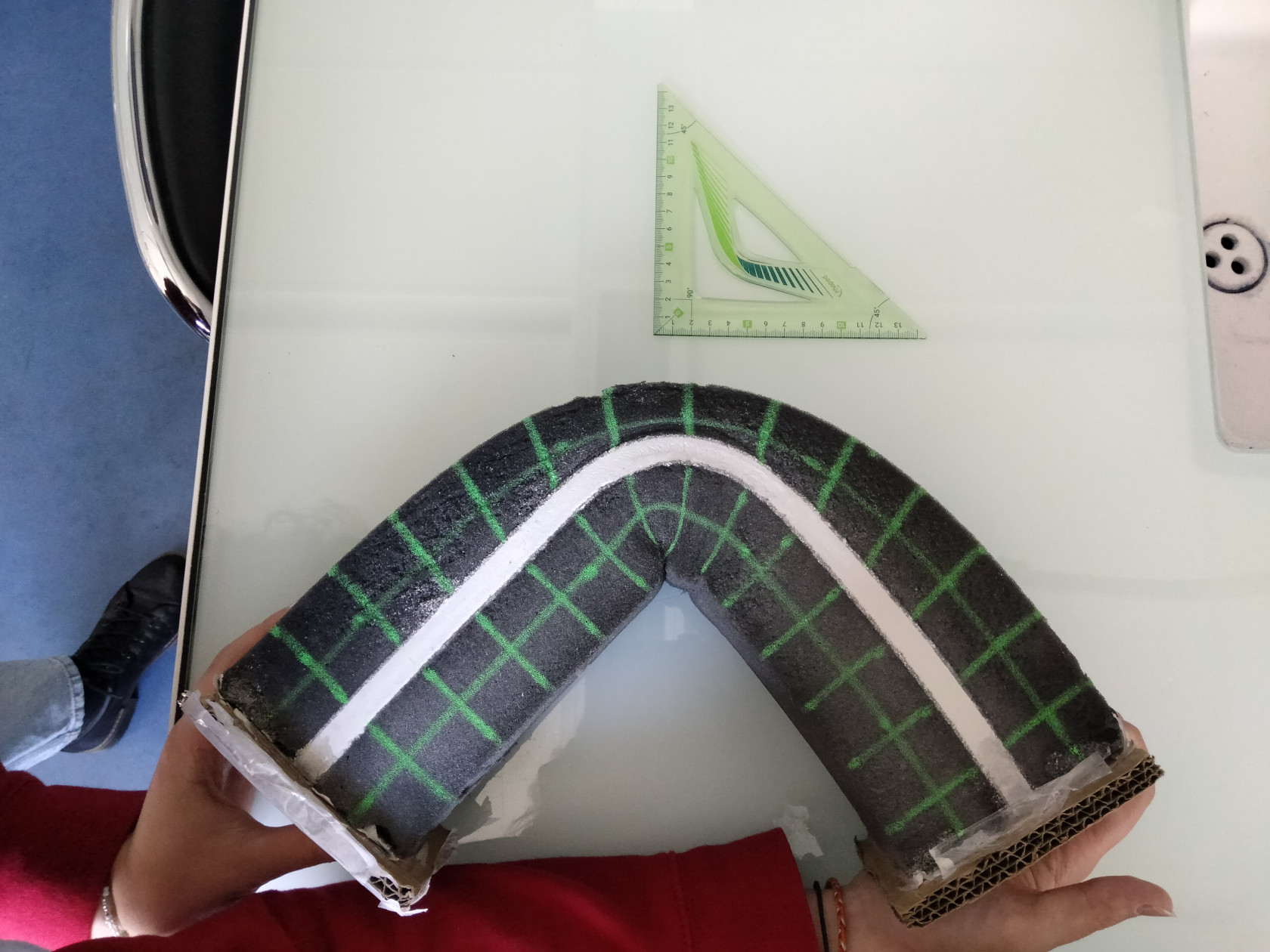
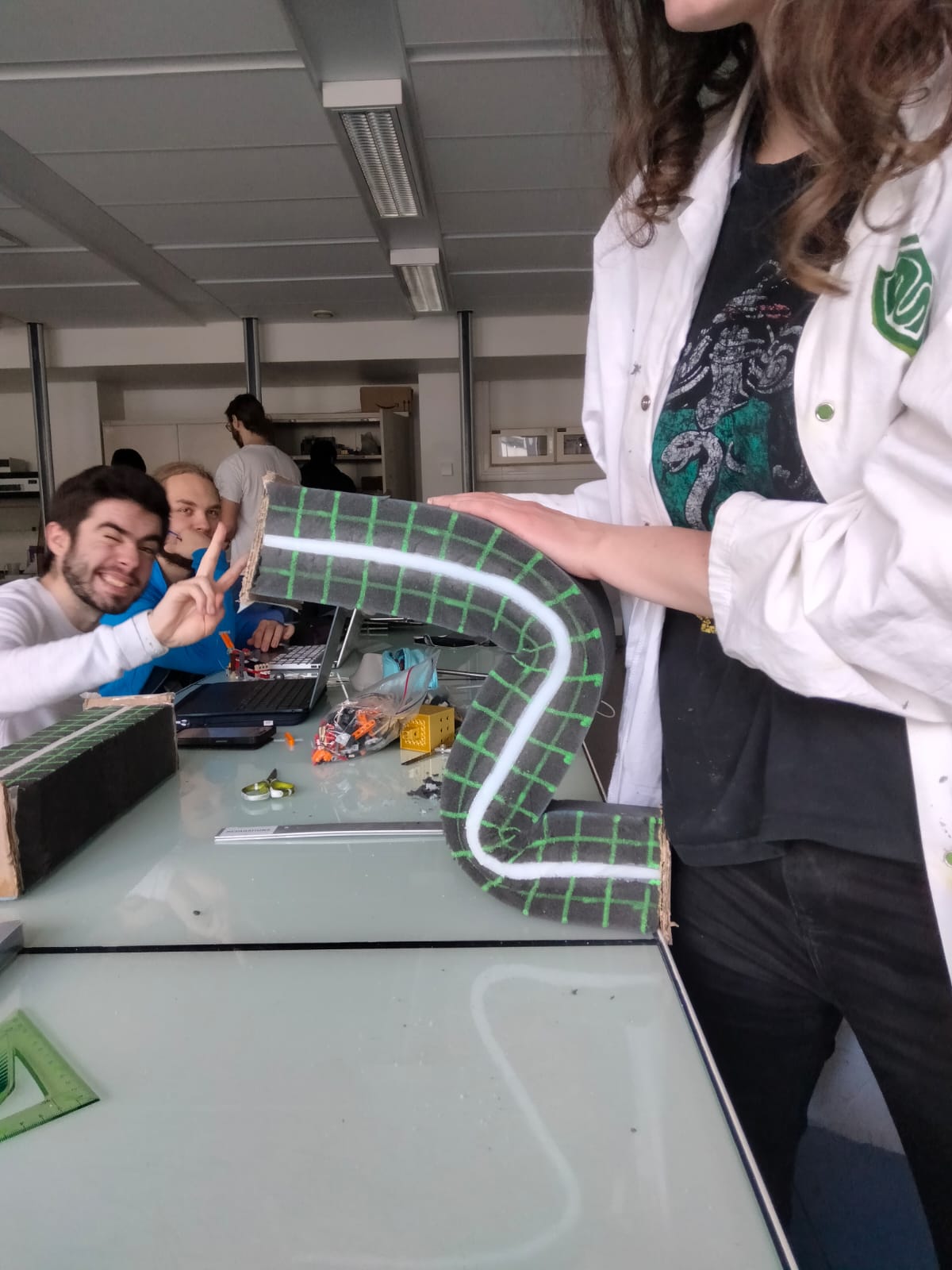
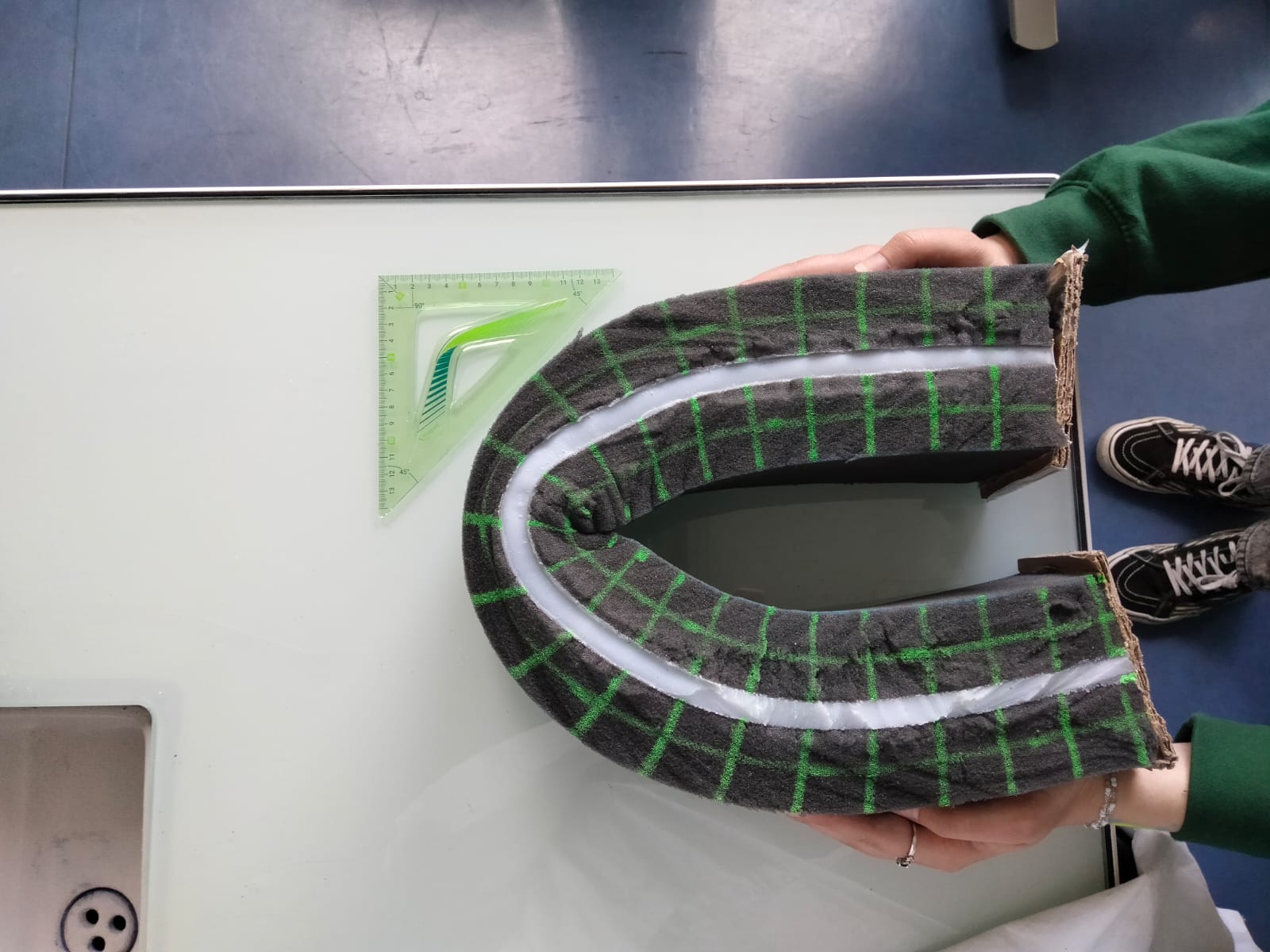
<span style="color: rgb(0, 0, 0);">Nous avons constaté que le silicone n'était pas aussi peu dense que nous le voulions et il a crée un gradient dans la mousse. Le gradient explique aussi peut-être pourquoi nous n'avions pas assez de silicone (hypothèse). De plus la couche de silicone de fond était trop solidement accroché donc nous avons dû scié le fond et le surplus de mousse ce qui donne un résultat moins propre. Le talk semble ne pas avoir fait autant effet qu'avec le silicone de la première expérience. </span>

<span style="color: rgb(0, 0, 0);">Nous avons tracé des repères pour constaté les extensions, etc. </span>

<span style="color: rgb(0, 0, 0);">Premier modèle : </span>

<span style="color: rgb(0, 0, 0);">[![WhatsApp Image 2025-05-09 at 15.01.32.jpeg](https://wiki.fablab.sorbonne-universite.fr/BookStack/uploads/images/gallery/2025-05/scaled-1680-/whatsapp-image-2025-05-09-at-15-01-32.jpeg)](https://wiki.fablab.sorbonne-universite.fr/BookStack/uploads/images/gallery/2025-05/whatsapp-image-2025-05-09-at-15-01-32.jpeg)[![WhatsApp Image 2025-05-09 at 15.01.29.jpeg](https://wiki.fablab.sorbonne-universite.fr/BookStack/uploads/images/gallery/2025-05/scaled-1680-/whatsapp-image-2025-05-09-at-15-01-29.jpeg)](https://wiki.fablab.sorbonne-universite.fr/BookStack/uploads/images/gallery/2025-05/whatsapp-image-2025-05-09-at-15-01-29.jpeg)</span>
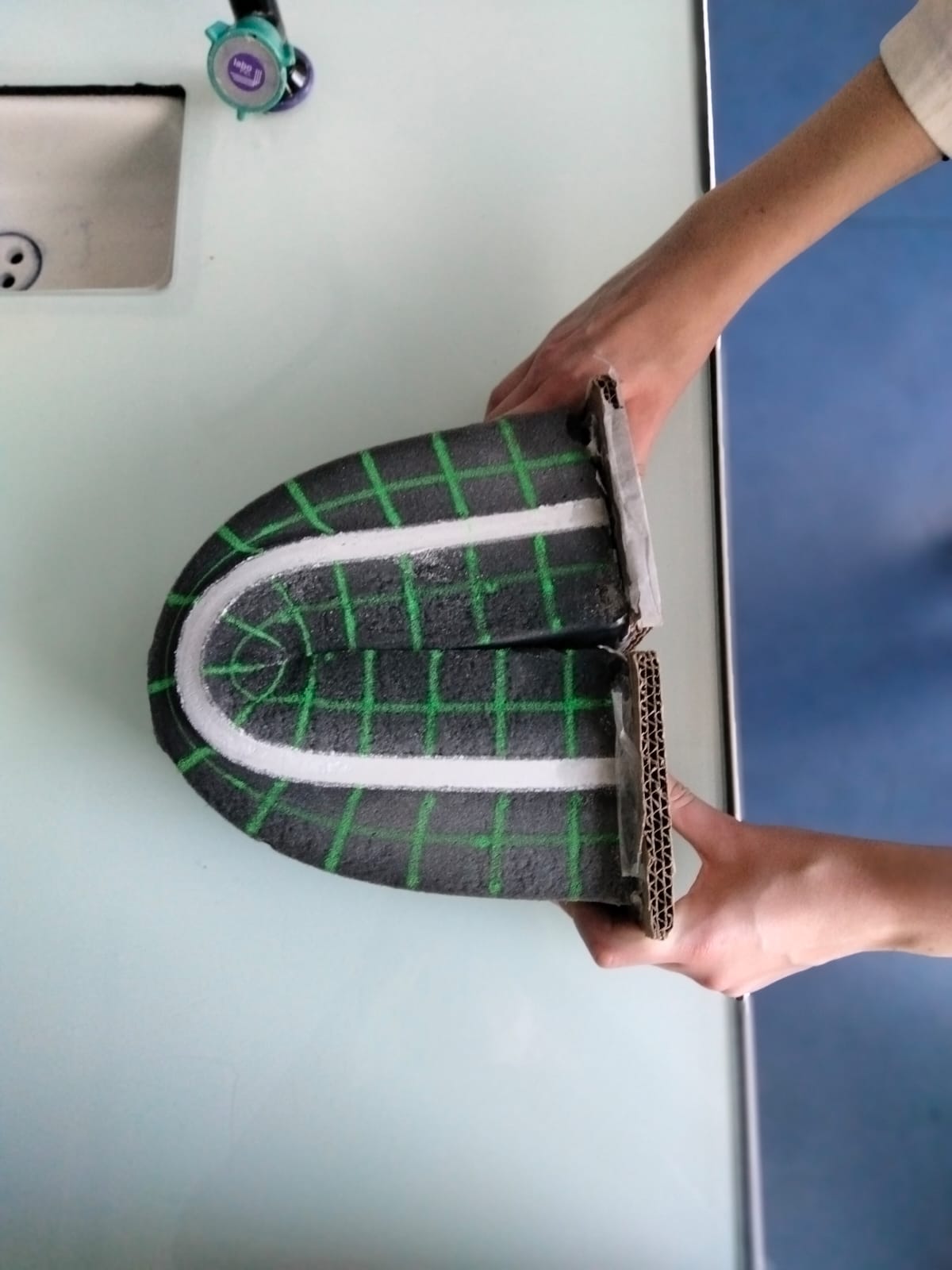
<span style="color: rgb(0, 0, 0);">Avec échelle : </span>

[![1-non-déformé.jpg](https://wiki.fablab.sorbonne-universite.fr/BookStack/uploads/images/gallery/2025-05/scaled-1680-/1-non-deforme.jpg)](https://wiki.fablab.sorbonne-universite.fr/BookStack/uploads/images/gallery/2025-05/1-non-deforme.jpg)[![1-déformé.jpg](https://wiki.fablab.sorbonne-universite.fr/BookStack/uploads/images/gallery/2025-05/scaled-1680-/1-deforme.jpg)](https://wiki.fablab.sorbonne-universite.fr/BookStack/uploads/images/gallery/2025-05/1-deforme.jpg)
<span style="color: rgb(0, 0, 0);">Deuxième modèle : </span>

<span style="color: rgb(0, 0, 0);">[![WhatsApp Image 2025-05-09 at 15.01.34.jpeg](https://wiki.fablab.sorbonne-universite.fr/BookStack/uploads/images/gallery/2025-05/scaled-1680-/whatsapp-image-2025-05-09-at-15-01-34.jpeg)](https://wiki.fablab.sorbonne-universite.fr/BookStack/uploads/images/gallery/2025-05/whatsapp-image-2025-05-09-at-15-01-34.jpeg)[![WhatsApp Image 2025-05-09 at 15.01.47.jpeg](https://wiki.fablab.sorbonne-universite.fr/BookStack/uploads/images/gallery/2025-05/scaled-1680-/whatsapp-image-2025-05-09-at-15-01-47.jpeg)](https://wiki.fablab.sorbonne-universite.fr/BookStack/uploads/images/gallery/2025-05/whatsapp-image-2025-05-09-at-15-01-47.jpeg)</span>
<span style="color: rgb(0, 0, 0);">Avec échelle : </span>

<span style="color: rgb(0, 0, 0);">[![WhatsApp Image 2025-05-09 at 15.54.52.jpeg](https://wiki.fablab.sorbonne-universite.fr/BookStack/uploads/images/gallery/2025-05/scaled-1680-/whatsapp-image-2025-05-09-at-15-54-52.jpeg)](https://wiki.fablab.sorbonne-universite.fr/BookStack/uploads/images/gallery/2025-05/whatsapp-image-2025-05-09-at-15-54-52.jpeg)[![WhatsApp Image 2025-05-09 at 15.54.47.jpeg](https://wiki.fablab.sorbonne-universite.fr/BookStack/uploads/images/gallery/2025-05/scaled-1680-/whatsapp-image-2025-05-09-at-15-54-47.jpeg)](https://wiki.fablab.sorbonne-universite.fr/BookStack/uploads/images/gallery/2025-05/whatsapp-image-2025-05-09-at-15-54-47.jpeg)</span>
</details><details id="bkmrk-22-mai-2025-r%C3%A9sultat"><summary>22 Mai 2025</summary>

<span style="color: rgb(0, 0, 0);">résultat pour le premier modèle :</span>

[![test2.png](https://wiki.fablab.sorbonne-universite.fr/BookStack/uploads/images/gallery/2025-05/scaled-1680-/test2.png)](https://wiki.fablab.sorbonne-universite.fr/BookStack/uploads/images/gallery/2025-05/test2.png)

</details>#### <span style="color: rgb(0, 0, 0);">Remerciements</span>

<span style="color: rgb(0, 0, 0);">A toute l'équipe de l'UE Fablab de Géosciences ainsi qu'aux responsables du Fablab Chimie/Biologie pour leurs conseils et leur temps. </span>

<div class="zInfos" id="bkmrk--33"></div>