# Synthèse des nanoparticules de Magnétite Fe3O4

<span style="color: rgb(0, 0, 0);">La magnétite colloïdale est formée par coprécipitation d’ions ferriques et ferreux en </span><span style="color: rgb(0, 0, 0);">milieu alcalin à température ambiante. La synthèse se fait en proportion stœchiométrique d’ions ferreux et ferriques.</span>

**<span style="color: rgb(0, 0, 0);"><span style="text-decoration: underline;"><span style="color: rgb(224, 62, 45); text-decoration: underline;">Cette synthèse sera réalisée sous sorbonne.</span></span></span>**

<span style="color: rgb(0, 0, 0);">1) Dans un bécher de 400 mL muni d'un agitateur magnétique, </span><span style="color: rgb(0, 0, 0);">verser</span><span style="color: rgb(0, 0, 0);"> 30 mL d’une solution aqueuse de chlorure ferrique   
</span><span style="color: rgb(0, 0, 0);">(\[FeCl<sub>3</sub>\] = 2 mol/L, M =162.2 g/mol) et y ajouter 11.9 g</span><span style="color: rgb(0, 0, 0);"> de sel ferreux tetrahydraté </span><span style="color: rgb(0, 0, 0);">(FeCl<sub>2</sub> .4H<sub>2</sub>O, M = 198,91 g/mol). </span>

[![Kokimage.png](https://wiki.fablab.sorbonne-universite.fr/BookStack/uploads/images/gallery/2025-03/scaled-1680-/kokimage.png) ](https://wiki.fablab.sorbonne-universite.fr/BookStack/uploads/images/gallery/2025-03/kokimage.png)[![image.png](https://wiki.fablab.sorbonne-universite.fr/BookStack/uploads/images/gallery/2025-03/scaled-1680-/Zdcimage.png)](https://wiki.fablab.sorbonne-universite.fr/BookStack/uploads/images/gallery/2025-03/Zdcimage.png)

<span style="color: rgb(0, 0, 0);">2) A l'aide d'une pipette graduée ajouter 2 mL d’acide chlorhydrique concentré</span><span style="color: rgb(0, 0, 0);"> en agitant. </span>

[![image.png](https://wiki.fablab.sorbonne-universite.fr/BookStack/uploads/images/gallery/2025-03/scaled-1680-/Dvjimage.png)](https://wiki.fablab.sorbonne-universite.fr/BookStack/uploads/images/gallery/2025-03/Dvjimage.png)

<span style="color: rgb(0, 0, 0);">3) Ajuster le volume total à 100 mL en complétant avec de l’eau distillée et agiter.</span>

<span style="color: rgb(0, 0, 0);">4) Attendre la dissolution totale du chlorure ferreux. A ce stade le mélange réactionnel est vert transparent. </span>

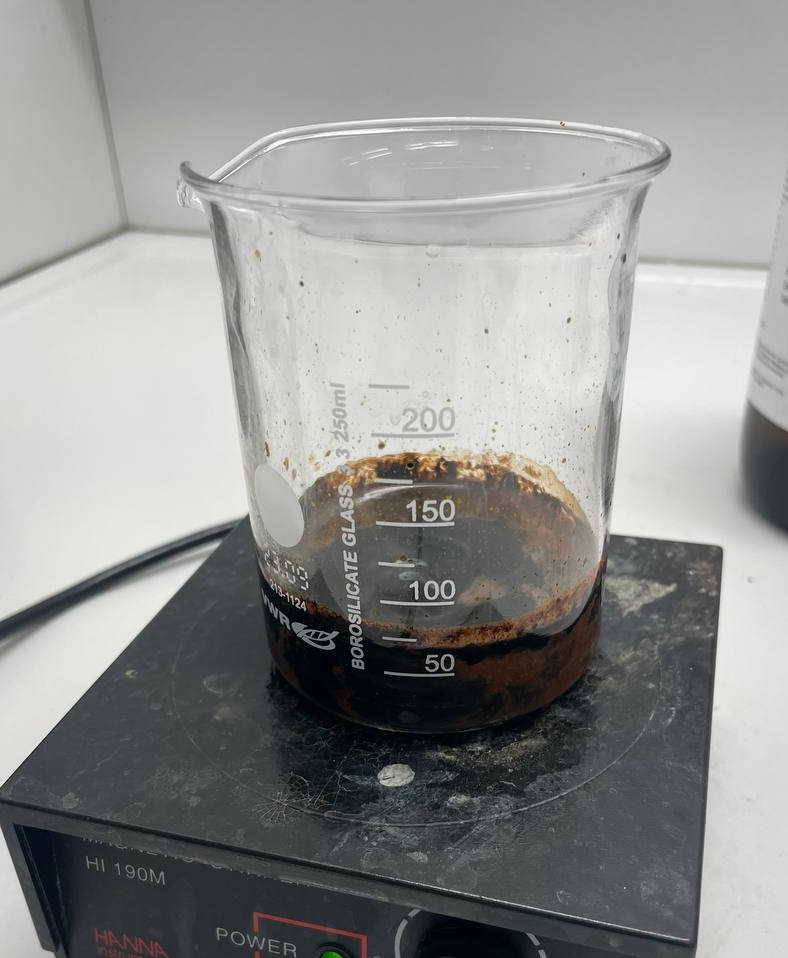
<span style="color: rgb(0, 0, 0);">5) Ajouter rapidement et sous forte agitation 25 mL d’ammoniaque concentrée </span><span style="color: rgb(0, 0, 0);">(NH<sub>3</sub> 30%). La solution devient quasi instantanément opaque marron foncé.</span>

[![image.png](https://wiki.fablab.sorbonne-universite.fr/BookStack/uploads/images/gallery/2025-03/scaled-1680-/Z2eimage.png) ](https://wiki.fablab.sorbonne-universite.fr/BookStack/uploads/images/gallery/2025-03/Z2eimage.png)[![image.png](https://wiki.fablab.sorbonne-universite.fr/BookStack/uploads/images/gallery/2025-03/scaled-1680-/jMiimage.png)](https://wiki.fablab.sorbonne-universite.fr/BookStack/uploads/images/gallery/2025-03/jMiimage.png)

<span style="color: rgb(0, 0, 0);">6) Maintenir l’agitation pendant 20 minutes.</span>

<span style="color: rgb(0, 0, 0);">7) Placer délicatement le bécher sur les plaques magnétiques. Attendre que les </span><span style="color: rgb(0, 0, 0);">particules magnétiques décantent. Enlever </span><span style="color: rgb(0, 0, 0);">le surnageant et garder le barreau </span><span style="color: rgb(0, 0, 0);">dans le bécher.</span>

<span style="color: rgb(0, 0, 0);">8) Ajouter 100 mL d’eau distillée pour laver les nanoparticules. Agiter pendant 5 minutes </span><span style="color: rgb(0, 0, 0);">et redécanter. Enlever le surnageant. Rincer une deuxième fois à l’eau et à nouveau enlever le surnageant. </span>

<span style="color: rgb(0, 0, 0);">[<video controls="controls" height="306" style="width: 844px; height: 416px;" width="617"> <source src="https://wiki.fablab.sorbonne-universite.fr/BookStack/attachments/1316"></source></video>](https://wiki.fablab.sorbonne-universite.fr/BookStack/attachments/1316)</span>